Preparation
Nav and reality
A dream of fjords, a crew and a forecast that forced a complete re-assembly of the route. We had to leave Kiel in the evening after work.
Stills from this chapter10 photos
Read the whole chapterCollapse chapter
The dream
I began planning Norway a year ago. Fjords had lived in my head since Douglas Adams’s ‘The Hitchhiker’s Guide to the Galaxy’, where Norway is Slartibartfast’s work: ‘Lovely crinkly edges. Won an award, you know.’
Preparation
Norway almanac bought, German and Danish sections reread, Grigory from the Meerbär blog questioned closely. He’d done a similar solo trip the year before: more valuable than any pilot book. Books give depths, lights and ports, but not third-day fatigue or the quiet question of why you began.
The original, serious plan: north through the North Sea from Heligoland. I asked Norwegian sailors about weather windows. For «Rassvet»an Ohlson 29, still near the edge of sensible. Strong boat; a long North Sea crossing remains a long crossing.
Preparation turned technical: a separate chat for route options, refuges, distances, passage times and fallback stops. Explore with Imray for local knowledge.
Crew
A Moscow woman contacted me through the blog in November or December. Nastya, planning Spain, keen to join.
We called. I explained: no leisurely coffee-and-sunset outing. Endurance, watches, little sleep, doing what’s necessary rather than pleasant. Agreed on that basis.
First meeting, 8 June. Original departure, Friday morning the 12th.
Forecast
‘Check weather’ sounds neutral. In practice, daily Windy on every model showed my careful route becoming a lesson in humility.
Strong wind after Friday lunch, then almost a week of gusts around forty knots or more. North Sea livelier still, fifty-plus in places.
Days before leaving, a full rethink. What happens to a dream when its North Sea window closes before departure?
The solution
Thursday, I knew Friday was too late. Leave then, meet deterioration. Stay, lose nearly a week and the trip’s momentum.
Simple, uncomfortable answer: after-work departure, overnight straight north while possible. North Sea abandoned. First target Grenaa. Then actual forecast: Skagen, Limfjord, or another improvised option.
The practical plan:
1. leave Kiel in the evening;
2. about 140 nautical miles north;
3. Grenaa as the first replanning point;
4. decide by weather, rather than wishes.
Grigory visited with an enormous shawarma and good wishes. He’d leave a week later, solo in the Midsummer Sail from the southern Baltic far north. Our plan almost looked moderate. Almost.
Departure
Thursday: aboard, provisions, gear stowed so no blind searching in night rain. Forecast checked again.
11 June, 9.30pm: cast off.
The journey began with compromise. Norway would depend on abandoning a beautiful idea at the right time, beyond drawing a line on a chart.
#passage
First passage
Keel → Gren
Night exit to the north and the first long passage. Grena has become a place to stop and look at the forecast again.
Stills from this chapter9 photos · 1 video
Read the whole chapterCollapse chapter
Night school
Two hours together as darkness covered Kiel Bay. I explained autopilot, instruments, course, speed, depth, watchkeeping. Nastya offered the first watch.
Almost training conditions: no wind, engine, autopilot straight towards Denmark. Four hours of letting the boat do dull, important work. I slept in snatches, up every thirty minutes to check.
First compromise. A watch formally covered; responsibility still the skipper’s, especially with someone’s first offshore night.
Following wind
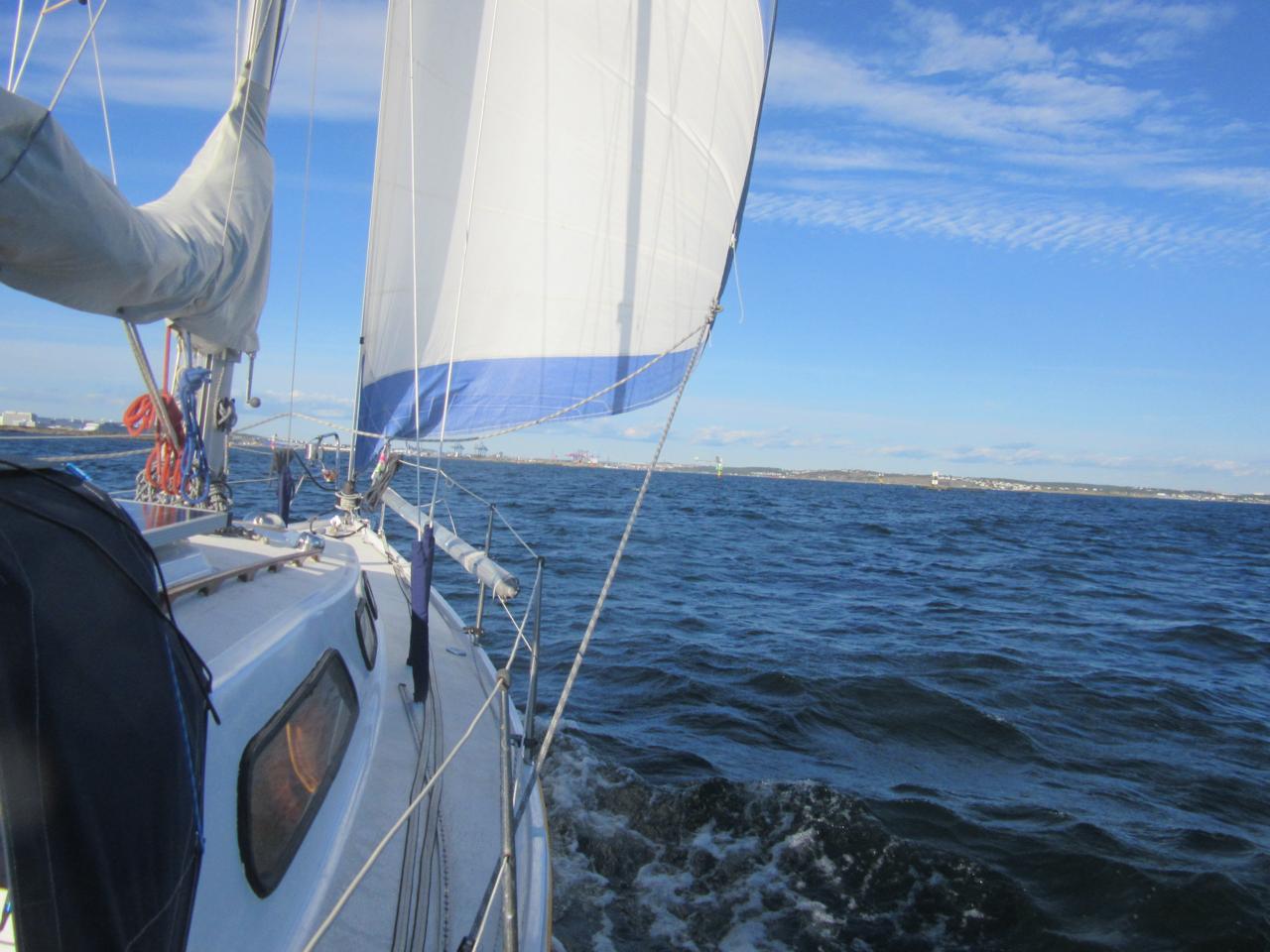
Morning watch, genoa unfurled. Plenty of commercial traffic, so outside main routes and avoiding unnecessary crossings.
Following wind throughout: eight knots initially, twenty-eight for hours near the end. Unfamiliar after three years mostly sailing close to the wind.
A useful downwind discovery: ease the genoa sheet further for more depth, and it’s less prone to flipping sides with rolling and shifts. When the clew loses drive, the filled sail pulls it forward, preventing a flop onto the other tack.
Twenty-six hours, about 140 miles. Under sail, Rassvet held five or six knots confidently only with about fifteen knots astern.
Route decisions underway
Langeland surprised me: DW and Route H shipping routes leave small craft limited inshore room. Manageable, but not relaxing.
Watches:
1. four-hour shifts work;
2. keep the timetable strictly;
3. daytime, everyone in the cockpit, it slips;
4. night exacts the cost in attention.
Night never fully arrived. Sun down at ten, glow until four, then day emerged from it. Darkness supplied, but sparingly.
Grenaa
Grenaa meant waiting out strong winds, replanning, tying up and exhaling. Then exploring.
Kattegatcentret, port, town centre. At the aquarium, straight through the shop, souvenirs bought, onward to fish, shark feeding, seals, coffee, most of the day inside.
Only leaving did I see ticket barriers opposite the shop, the exit. We’d entered through it and visited free. Awkward.
Lunch at Havets Bord: a mountain of fried, boiled and smoked fish, peeled prawns and little roe. Could fish alone fill me up? All later meals cancelled, including dinner. Experiment settled.
Pause
Wind wasn’t the only delay. A strange illness struck: right-temple headache into the eye, nausea, confusion. About forty-eight hours, gradually easing. Nurofen and No-Spa didn’t help.
Pressure, dehydration, migraine, stress, seasickness, exhaust fumes, something else? Main thing: don’t sail with symptoms I don’t understand.
Choice: keep aiming for Stavanger and more long passages, or Oslofjord, then short coastal hops south along Sweden’s west coast.
The plan breaks. Safety must come first; resembling the dream comes afterwards.
#passage
Passage weather
Denmark → Sweden
Gren → Lesø → Malmön
Westerly beam reach, fifteen to twenty-three knots in gusts. Second reef in main, full genoa. In hindsight, furl some genoa too: rounding up in gusts made extra speed less worthwhile than fighting the helm. Sixty-one miles in eleven hours. Respectable figures; eleven hours of constant rolling. Glad I’d taken seasickness medicine. Læsø West-side berth with a stern mooring line.
Stills from this chapter10 photos
Read the whole chapterCollapse chapter
From Grenaa
16 June, 5.30am, refuelled and north towards Læsø.
Westerly beam reach, fifteen to twenty-three knots in gusts. Second reef in main, full genoa. In hindsight, furl some genoa too: rounding up in gusts made extra speed less worthwhile than fighting the helm.
Sixty-one miles in eleven hours. Respectable figures; eleven hours of constant rolling. Glad I’d taken seasickness medicine.
Læsø
West-side berth with a stern mooring line. After familiar German and Danish piles, a coordination test: approach, catch windward bow line, pick up dirty mooring line, haul aft, cleat, look as if planned.
We walked village and beach. Quiet, so quiet I didn’t want several days. Tomorrow, south-westerly ten to fifteen knots. After stagnation, don’t waste it.
Navily, Navionics, Windy. Next target: Bohus-Malmön, Sweden.
Genoa alone
17 June, eight o’clock. Following wind, full 140% genoa. Main initially up, quickly down when almost running: blanketing the genoa, and no spinnaker pole aboard.
Often six knots. Briefly the advertising version of sailing: following wind, open water, yellow hull, Sweden ahead.
Halfway, two-metre waves: long ocean swell, slowly lifting and lowering us. Apparently leaving sheltered Kattegat for Skagerrak at last.
Busy shipping too. AIS made calculation possible: course, speed, CPA, TCPA, then choose a crossing gap. Its purpose is knowing where you shouldn’t be in time, beyond technological pride.
Into Sweden
Malmön felt a different sea: granite, enormous smooth rocks, skerries. Suddenly northern after Denmark.
Alongside the visitors’ pontoon. After Læsø’s mooring line, almost hotel parking: approach, alongside, lines, no foredeck circus.
Four-by-two-kilometre island. Coastal loop marked blue and white. Surprisingly absorbing, searching for painted rocks, climbing occasional viewpoints over the majestic sea.
Surf below, granite around, Skagerrak ahead. Every earlier decision suddenly seems right, having brought you here.
Lessons from two passages
1. full genoa on a beam reach in fifteen to twenty-three knots may be too much, despite speed;
2. a large genoa works better alone downwind;
3. AIS turns shipping anxiety into calculations;
4. use good wind when boat and crew are ready.
For the island walk, take a Coop prawn sandwich. Not navigation information; equally important.
#passage
Passage weather
Swedish skerries
Munkholmen and Dannemark
In Grenaa, a neighbour listed twelve west-Swedish places and lent Hamnguiden 5 by Hanne and Jørn Engevik. Dangerous, in a good way. Aerial photos: skerries, approaches, depths, boats for scale, mooring rings in rock. Clear places to tie ashore or hold the boat off. I soon wanted a rocky-island berth. 19 June, a quiet sixteen-mile passage to Munkholmen. First attempt Northern rings first. Sheltered, still, beautiful: the picture selling rock mooring.
Stills from this chapter9 photos · 1 video
Read the whole chapterCollapse chapter
A tempting pilot book
In Grenaa, a neighbour listed twelve west-Swedish places and lent Hamnguiden 5 by Hanne and Jørn Engevik.
Dangerous, in a good way. Aerial photos: skerries, approaches, depths, boats for scale, mooring rings in rock. Clear places to tie ashore or hold the boat off. I soon wanted a rocky-island berth.
19 June, a quiet sixteen-mile passage to Munkholmen.
First attempt
Northern rings first. Sheltered, still, beautiful: the picture selling rock mooring.
But southerly gusts to twenty overnight. Beauty second, safety first.
Ashore, bird droppings almost everywhere. Walking a minefield.
Bow and stern lines. Half a metre from rock, unable to pull closer. A small wave arrived; instead of rocking gently, the boat jerked upright. Halyards hit the mast.
An expensive sound.
Apparently, the keel’s side touched a granite ledge. Enough to rule out sleeping there.
Second attempt
Southern rings, boat stretched between them. A hollow meant only bow and stern touched rock; fenders looked decorative. Acceptable in stillness, but not testing yellow hull against five-storey granite overnight.
A few hours, no night here.
A daytime stop
Then what skerries are for: drone for me, sketching for Nastya, fruit-and-yoghurt salad, beginner fishing.
First time touching spinning rod, plug and spoon. Nastya, experienced, showed me casting and their differences. No catch, but I irritated some small fish. €35 AliExpress kit works. Fish holding their ground.
Sunset cooled the rock fast. Large armoured centipedes, a finger and a half wide, emerged from cracks. A psychological addition to the berth.
I imagined them crossing the lines aboard. Convincingly enough to suggest Dannemark Bay by Ulön instead.
The night option
Five buoys, four occupied: Norwegian, Swedish, French, Danish flags. Our German one completed the little international gathering.
Free buoy taken. More trust after the rocks than anchoring on unknown ground. Anchor alarm still on.
A lively night’s wind. Several bearing checks to confirm we stayed put. Perhaps two lines to the buoy would have reassured me. Maybe overcautious.
Comfortable night.
Lesson: rings in a pilot book don’t replace inspecting the berth. Depth beneath keel, rock shape, overnight wind, fender contact, boat motion in an occasional wave, beyond perfect calm.
#passage
Passage weather
Swedish skerries
Dannemark → Bonfire
20 June 2026. A yellow thunderstorm warning had been in every forecast since evening. Even in the morning, I wasn’t sure about leaving. Gusts to 35 knots after seven; not one yacht on AIS. Half an hour later, two boats appeared along the skerries. Proof of nothing, but another route option. I plotted inner passages, rocks sheltering most of the way from open seas and strong wind, though not the thunderstorm itself.
Read the whole chapterCollapse chapter
A voyage through the Skagerrak. Part 5. Dannemark → Koster
Yellow warning
20 June 2026. A yellow thunderstorm warning had been in every forecast since evening. Even in the morning, I wasn’t sure about leaving. Gusts to 35 knots after seven; not one yacht on AIS.
Half an hour later, two boats appeared along the skerries. Proof of nothing, but another route option. I plotted inner passages, rocks sheltering most of the way from open seas and strong wind, though not the thunderstorm itself.
We slipped the buoy, unfurled the genoa and left without engine.
Slow counts too
For hours, I fought for every tenth of a knot. Below five, trim, alter course, sometimes engine. Then I realised I was maintaining a number on a screen rather than making a passage.
Lowered my threshold to four. Sometimes 3.5, but in the right direction, shelters ahead, enough time. Arrival time stopped mattering. We were sailing.
Five hours nearly silent, no engine or autopilot. Tiller in hand among stone islands. Once, wind to twenty, but the next sheltered passage was right there.
More turns, constant chartwork, no long distraction: the price. In return, five hours of skerries we’d otherwise see only on the plotter.
Towards Koster
Last hour, wind gone, motored to Koster, recommended by several people, including the Grenaa gentleman who lent his pilot book.
Alongside a short finger pontoon. After buoys, rock rings and granite negotiations, ordinary berthing felt futuristic.
Koster lies in Kosterhavet marine national park. Starfish and crabs visible by shore, paths over rocks along the water.
A threat ashore
Nastya stepped towards an information board and felt a prick at her ankle. Macro photography showed a tick. Aboard, we removed it and disinfected the bite. Two more ticks on her trousers, something suspicious on my T-shirt.
I asked ChatGPT about Swedish practice, then checked local recommendations. Surprisingly brief: remove promptly, wash, watch skin and health for several weeks. Preventive antibiotics after an ordinary bite aren’t recommended here.
A little early redness needn’t mean anything. Seek medical help for expanding redness one or several weeks later, particularly over five centimetres, or fever, headache or pronounced illness.
Vaccination protects against TBE, not Lyme disease, and needs doing beforehand, rather than after a bite. I found nothing on myself. Little comfort; keep watching.
Thunderstorm warning and shelter planning in the morning, tick-bite monitoring at night. The sea was more predictable than land this time.
Passage weather
To Norway
Bonfire → Fuglevik
For 22 June, Koster to Fuglevik on Norway’s Oslofjord coast, about thirty miles direct. Diesel and water there to replenish supplies. The forecast offered little clarity: wind adverse, easing, briefly useful. So leave in the morning, main up, motor into it. About 3–3.5 knots. Tacking without engine was possible, but substantially longer in distance and time. I saw no benefit. The ferry Before the fjord, AIS warned of a close approach by a large ferry.
Read the whole chapterCollapse chapter
A voyage through the Skagerrak. Part 6. Koster → Fuglevik
No sailing heroics
For 22 June, Koster to Fuglevik on Norway’s Oslofjord coast, about thirty miles direct. Diesel and water there to replenish supplies.
The forecast offered little clarity: wind adverse, easing, briefly useful. So leave in the morning, main up, motor into it.
About 3–3.5 knots. Tacking without engine was possible, but substantially longer in distance and time. I saw no benefit.
The ferry
Before the fjord, AIS warned of a close approach by a large ferry. I considered altering to clarify our intentions, but she changed course early and passed astern.
With the engine running, we were a power-driven vessel despite the main. No expectation of being given way to as a sailing yacht. Why she altered, I don’t know; perhaps simply the clearest option.
Inside, waves vanished and speed rose to 4.5 knots. Blue mountain ridges along the west coast caught my eye at every turn.
Hard to see
Fishing gear caused the tension. Markers every half-mile, not all bright: dark-blue cans, little flags.
Find one, search for its partner, mentally draw the gear between. Two or three pairs nearby turned peaceful motoring into concentration practice.
Visible by day, perhaps; a blue can at night on an unfamiliar route, less so. My desire to sail here after dark diminished.
Fuglevik
Thirty-four miles, eight and a half hours. Finger berth, twenty litres of diesel immediately.
Then payment for berth, shower, power: no clear instructions, nobody to pay. Unlimited facilities in the end. Guilty, slightly pleased.
Another mismatch ashore: no shops, parks or museums. A small campsite settlement, Moss just two miles farther. Some regret.
In the evening, I stood on the slope above the sea. Towns lit up opposite: dark water, thousands of lights, the blue ridges that had followed us all day.
Still a remote marina. Just not necessarily a disadvantage.
Passage weather
Oslofjord
Fuglevik → Oslo
23 June, a high and almost no wind forecast. Prepared for eight hours motoring to Oslo. A gift instead: following wind almost throughout, Rassvet sometimes reaching six knots. Rocky ridges both sides, surprisingly little large traffic. Thirty-five miles, one ferry, one cargo ship, one liner. Kiel or Solent would bring dozens. Local yachts comfortably near mid-channel. Natural that day, but I watched AIS and astern.
Stills from this chapter10 photos
Read the whole chapterCollapse chapter
A different forecast
23 June, a high and almost no wind forecast. Prepared for eight hours motoring to Oslo.
A gift instead: following wind almost throughout, Rassvet sometimes reaching six knots. Rocky ridges both sides, surprisingly little large traffic. Thirty-five miles, one ferry, one cargo ship, one liner. Kiel or Solent would bring dozens.
Local yachts comfortably near mid-channel. Natural that day, but I watched AIS and astern. A helicopter rescue exercise, someone lowered to a boat.
In the centre
Eight hours to central Oslo marina. A staff member met us on the pontoon: after buoys, rings and fingers, almost service.
Eighteen NOK per foot, about €50 a night for twenty-nine feet. Excessive at first; then suburban transport, free showers and laundry, nearby shop, ten minutes to museums. Perhaps cheaper overall.
Norwegian essentials sampled: Solo like Fanta with fizzy vitamin C; Kvikk close to KitKat; brunost like caramelised condensed milk, best with Polarbrød. By slice three, I understood thin slicing.
The car
Next morning, the starboard genoa car’s locking pin had torn out. No fixing to the track, no reliable sheet-block positioning.
Calliper first: rail width and profile, hole diameters, car dimensions, sent to sellers. Several conversations found an 800 NOK J/70 car.
It didn’t fit.
Careful Dremel removal of metal at the edges. Sunglasses stopped big particles; proper enclosed goggles and a mask would have been right. Original block incompatible too. Another trip across Oslo’s outskirts for a Harken block.
About six hours and €200: half the city, metal shavings, two shop trips, two petrol-station hot dogs and Cokes.
An adapted compromise, beyond a standard replacement. Checked free travel, full pin engagement, block and fixings moving under load without binding.
About 380 miles from Germany to Oslo, first full day hunting a genoa car: perfectly consistent travel. Another small failure solved the usual way: money, time, a tool previously considered optional.
#passage
Passage weather
Stopover
A day in Oslo
Yesterday left me gloomy. A major destination reached: Skagerrak swell and traffic crossed, fifty-mile Oslofjord navigated, central-capital berth. Apparently all to tour the outskirts for a €200 car that wouldn’t fit its track. I decided to get my money’s worth from museums. Already visited National Museum, Munch and Astrup Fearnley years ago, so Bygdøy’s three museums this time.
Stills from this chapter10 photos
Read the whole chapterCollapse chapter
Yesterday left me gloomy. A major destination reached: Skagerrak swell and traffic crossed, fifty-mile Oslofjord navigated, central-capital berth.
Apparently all to tour the outskirts for a €200 car that wouldn’t fit its track.
I decided to get my money’s worth from museums. Already visited National Museum, Munch and Astrup Fearnley years ago, so Bygdøy’s three museums this time.
Norsk Folkemuseum was a little town within the city: houses and interiors through the ages, farm buildings to flats, shops, petrol stations and multi-storey outdoor toilets.
In the Fram Museum the real wooden polar ship of Nansen, Sverdrup and Amundsen stands inside. Go aboard, see how people travelled into so much blank map.
What affected me most was Kon-Tiki.
Grisha told me Thor Heyerdahl’s story only a month ago, on our Danish flotilla. A sea yarn allowed some implausibility. Now the raft before me.
His theory: Polynesia might have settlers from South America as well as the west. Little scientific enthusiasm. One objection: ancient vessels couldn’t cross the Pacific.
His reply went beyond ordinary debate: build a raft and test it.
Five companions, US military radios and rations, Peru’s presidential support, balsa-log raft. Callao departure in 1947, square sail, little shelter, parrot. Raroia in French Polynesia 101 days later.
A full-size Kon-Tiki reconstruction lay in the museum. Logs, tiny hut, sail. Six people for over three Pacific months, storms, sharks, problems never covered by the design.
I wanted his book for daily life more than theory. When did people predicted to die horribly stop seeing a scientific experiment and realise they simply had to get across?
An aged Heyerdahl waxwork at the end. Usually awkward things; after raft, photos and story, I stood looking for a long time at that extraordinary mixture of academic science and courageous adventure.
Back aboard Rassvet, tired and drained.
Nastya looked at me:
‘I’m fed up here. Want to get away.’
‘Leave now?’
‘Yes. Let’s.’
#passage
Oslo → Horten → Fredrikstad
Escape from Oslo
I felt calm about leaving Oslo after a hard day. Several reasons. The previous night, reading until three, I went out to brush my teeth: night hadn’t arrived. Orange twilight one side, pale blue the other, no stars. Late June at sixty north, darkness was a formality. Two people meant watches and short sleeps. Calm fjord overnight, southerly headwind in the morning. Better smooth-water motoring than fighting both wind and short chop.
Stills from this chapter10 photos
Read the whole chapterCollapse chapter
Why at night
I felt calm about leaving Oslo after a hard day. Several reasons.
The previous night, reading until three, I went out to brush my teeth: night hadn’t arrived. Orange twilight one side, pale blue the other, no stars. Late June at sixty north, darkness was a formality.
Two people meant watches and short sleeps. Calm fjord overnight, southerly headwind in the morning. Better smooth-water motoring than fighting both wind and short chop.
Fishing gear also mattered less inside the fjord, after the blue cans on our northward route.
25 June, ten at night, Oslo towards Horten. An easy night indeed. Arrived at five.
Three thousand miles
Horten grew around Karljohansvern, once Norway’s main naval base. Now naval museum, submarine, ships, turrets, marine equipment.
But the museum wasn’t the memorable event.
In Oslo, I’d jokingly boasted of three thousand logbook miles. A pleasant number to say. Nastya remembered.
In Horten, she went shopping alone for candles and a small Napoleon cake, then surprised me with a three-thousand-mile celebration aboard.
Completely unprepared. Laughed, then almost cried. After watches, repairs, forecasts, distance calculations, someone saw what the number meant and made an event of it.
Small cake, small candles. Enough.
Football silence
26 June evening, Norway–France. Locals gathered at the marina bar with horns, drums and optimism.
Loud first, then deathly quiet, almost a cemetery. Unusual football crowd.
Phone out: 1–4 to France.
A funeral indeed. Felt sorry for Norway. Slept beautifully.
A town from yacht adverts
27 June, eight, towards Fredrikstad by two.
I’d seen its name repeatedly in Norwegian yacht adverts. Curious about this sailing centre near Sweden. At the Glomma mouth, with a long river approach.
Expectations differed: one central visitors’ marina, no facilities. Bought stove alcohol, searched elsewhere.
Across the river, no visitors’ berths in one marina, no-visitor sign in the next.
Already turning away when an older gentleman approached by dinghy. What were we seeking? Berth beside them, facilities code available, no charge.
Three refusals in an hour, then someone came over by dinghy to offer free shelter and codes.
I hadn’t expected miracles still, or that they might arrive by dinghy.
#passage
Passage weather
Fredrikstad → Strömstad
Back in Sweden
28 June 2026. We left Fredrikstad for Strömstad. Almost the whole passage was to windward, sailing close-hauled and tacking. There was hardly any sea, and the sun was hot, so despite the wind direction it was a surprisingly comfortable trip. The fishing gear hadn't gone away. Sometimes we passed four sets in a row, which made it hard to relax: spot one buoy, immediately look for the second, then work out where the net runs between them.
Stills from this chapter5 photos
Read the whole chapterCollapse chapter
Back in Sweden.
28 June 2026. We left Fredrikstad for Strömstad. Almost the whole passage was to windward, sailing close-hauled and tacking. There was hardly any sea, and the sun was hot, so despite the wind direction it was a surprisingly comfortable trip.
The fishing gear hadn't gone away. Sometimes we passed four sets in a row, which made it hard to relax: spot one buoy, immediately look for the second, then work out where the net runs between them.
At one point I needed to stand further out to sea to get a better wind angle and stay on one tack for as long as possible. Another yacht was sailing parallel to us, with her mainsail sheeted almost to the centreline and a self-tacking jib.
We overtook her. A little later her skipper tacked, made some distance off and headed back towards the shore. His boat couldn't point as high as Rassvet, so he bore away a little, picked up speed and crossed about fifty metres ahead of our bow.
Then he did it again.
On his third attempt, he tacked and came straight at us.
I'd already got the horn out. The distance was closing, while his intentions were becoming approximately no clearer at all. About fifteen metres away, he finally bore away sharply onto an almost downwind course and passed astern.
That day left me with a few prejudices against self-tacking jibs. Possibly entirely unfair ones. But when tacking every half-hour costs someone no effort, everyone around them has to keep an eye on the consequences.
A new routine
I'd happily have stayed another day in Fredrikstad, where berthing was free, but the forecast promised a sharp deterioration. We planned to spend three nights in Strömstad waiting out the strong winds. I also hoped Sweden might prove a little cheaper after Norway.
But wind wasn't going to be the main challenge over the coming days.
My holiday was over.
The original voyage plan revolved around a fairly dubious experiment. The first two weeks of leave were for getting a long way north. Then I'd work remotely for three weeks, gradually heading back in short hops. After that, another two weeks of leave would allow some proper sailing and a return to Kiel without racing the clock.
Those three weeks were now beginning.
I'd be working from 07:00 to 16:00. Then I could close the laptop, cast off and cover another 10–25 miles to the next harbour. Perhaps not every day: the prospect of ending every working day with a passage for several weeks soon loses some of its romance.
I was a little nervous. Until now the boat had been either transport or somewhere to relax. She was about to become my office too.
Starlink
It was for this part of the voyage that I'd bought Starlink. My unlimited plan cost €99 a month and meant work wouldn't tie me to any particular marina.
Over the following weeks I gathered a few figures:
• downloads were usually 100–150 Mbps;
• uploads around 20 Mbps;
• latency 30–50 ms;
• a full working week used roughly 100 GB of data;
• occasionally the connection froze for two or three seconds;
• two simultaneous video calls could make it struggle, so Nastya and I started comparing our important meeting times beforehand.
Otherwise it worked so well that it soon stopped feeling unusual. In the morning I'd open my laptop in the cockpit or cabin and join work meetings much as I would from home.
I powered it from a 12-volt connection. I saw consumption reach roughly 5 A, making Starlink a significant item in the boat's energy budget. It wasn't something I could simply install and forget, particularly on cloudy days when the solar panels produced less.
We arrived in Strömstad as more than travellers waiting out another storm.
At seven the next morning, I had to be at work.
#passage
Passage weather
Work and skerries
First week of remote work
After three nights in Strömstad the storm ended, and the real test of my plan began. At 16:00 I closed the laptop, cast off and we headed for Havstenssund. Just 13 nautical miles, almost entirely under engine into the wind. North-western Sweden was stunning. You can spend hours winding between rocky islands and skerries, constantly changing course and studying the next passage, which a minute earlier wasn't visible at all.
Stills from this chapter8 photos · 2 videos
Read the whole chapterCollapse chapter
After work
After three nights in Strömstad the storm ended, and the real test of my plan began.
At 16:00 I closed the laptop, cast off and we headed for Havstenssund. Just 13 nautical miles, almost entirely under engine into the wind.
North-western Sweden was stunning. You can spend hours winding between rocky islands and skerries, constantly changing course and studying the next passage, which a minute earlier wasn't visible at all.
In Havstenssund we berthed alongside by a small fishing village. I'd have liked to stay longer, but another spell of strong wind was on its way, so there wasn't much room to relax the schedule.
Walking along the pier that evening, I noticed a splash. Then another. Fish were jumping clear of the water every few minutes.
I went back to the boat for my spinning rod and began casting a lure from the pier in the glow left by the setting sun. Twice I lifted a small herring, about twenty centimetres long, out of the water, and both times it came off almost immediately. The hook was probably too big. Still, it was the first fish I'd managed to get airborne in about twenty years. Let's call it a partial success.
The engine had also clocked up about 80 hours since I'd fitted the new propeller shaft seal. I added a little grease and entered the maintenance in the logbook.
€110 for a good view
The next day, after work, we cast off again and headed for Hamburgsund.
The village sits in a narrow sound between rocky shores. It feels unusual: seagoing yachts, salt water and granite all around, yet the harbour itself feels more like a river.
We were going to wait out another storm here. Only all the visitor berths were full.
I spotted a completely empty pontoon by a restaurant and assumed sailors were avoiding the awkward arrangement with a stern mooring buoy.
Once €110 had left my card, it became apparent there might be another explanation. More expensive than a berth in central Oslo. Payment was through Dockspot. The spot itself was lovely, though.
Sea fire
Out at sea I'd noticed long brownish-red streaks on the surface a few times. In the marinas they gathered by the shore, looking more like dirt or an algal bloom.
That evening it began to drizzle.
I went outside and saw each raindrop flash blue for an instant as it struck the water beside the boat. A glowing ring spread from it, then another drop fell, and another. Within seconds the whole surface in front of me had become a tiny cosmic scene.
That was my first sight of mareld, Sweden's ‘sea fire’.
I stood in the rain watching the water for quite a while. Sometimes plankton and bad weather are all you need for a good evening's entertainment.
The next day I took a ride on the local cable ferry. As it set off and slowed down, the steel cable tightened and rose out of the water in places. Afterwards I was particularly reluctant to imagine my own yacht directly above it at the wrong moment.
Week one
And so the first week of remote work slowly came to an end.
Before starting the experiment, I'd worried about a rather mundane issue. In many marinas you have to leave your visitor berth around noon or pay for another night. I physically couldn't leave at twelve, because I'd be at my laptop until four or five.
It made for an odd way of travelling: work from the cabin in the morning, close the laptop in the afternoon, move 10–20 miles, berth somewhere new in the evening, then open the same laptop again the next morning.
During that first week, not one harbourmaster asked me to leave before the end of my working day or charged me an extra night for those few additional hours.
So, for now, the plan was working.
I also bought Coca-Cola-flavoured dates. If you come across them in Northern Europe, get some. This has nothing to do with working remotely on a yacht, but useful information doesn't always have to be about boats.
#passage
Passage weather
Hamburgsund → Malmön
Nothing but waves and sky
On 3 July, the storm with winds of 35 knots and more that had kept us in Hamburgsund for the previous couple of days was supposed to end after 14:00. We were finishing work and preparing to leave. As I readied the boat, I got talking to our neighbour. He gently pointed out that it was still blowing hard at sea. I shrugged: the forecast had it dropping to 18–26 knots.
Stills from this chapter8 photos · 2 videos
Read the whole chapterCollapse chapter
A warning
On 3 July, the storm with winds of 35 knots and more that had kept us in Hamburgsund for the previous couple of days was supposed to end after 14:00. We were finishing work and preparing to leave.
As I readied the boat, I got talking to our neighbour. He gently pointed out that it was still blowing hard at sea. I shrugged: the forecast had it dropping to 18–26 knots.
He said there could be big waves between the rocks on the way out of Hamburgsund, but it would be calmer further out in open water. I'd seen about two metres in the forecast and simply thanked him.
For some reason the conversation wouldn't end. It was clear he was trying to tell me something without lecturing me.
Eventually he gave up:
‘If I were you, I wouldn't go anywhere today.’
I replied that 18 knots and two-metre waves sounded quite manageable. Besides, I really didn't want to pay another €50 for the night.
We smiled and wished each other luck.
Exactly where I didn't want to go
Between the rocks it was calm, with almost no wind. I'd begun to think our neighbour had simply been overcautious.
Before the next turn, a narrow gap appeared to starboard, with waves crashing against the rocks. A thought flashed through my mind:
‘Please, not that way.’
A hundred metres later, Navionics told me to turn precisely that way.
Rocks protruded on both sides. Waves smashed against them, throwing foam high into the air. I had to keep roughly in the middle of the passage and head straight into the approaching seas.
They looked nothing like the forecast two metres.
Every few seconds the depth sounder jumped from about 10 metres to 18 and back again. The boat climbed, her bow pointed at the sky for a while, then we dropped. Every cycle tightened my chest.
More than anything, I wanted to turn round.
But I wanted even less to be beam-on to those waves.
So I held our course, repeating our neighbour's words to myself: big waves first, then smaller ones.
In my memory that passage lasted about an hour. The Navionics track insists it was ten minutes. We haven't reached an agreement on that.
Nothing but waves and sky
It did get easier further out. But I soon noticed something else: whenever the route approached shallow water, the waves grew higher and steeper again. I had to rework the route as we went, avoiding the shallower patches.
Once we had about 50 metres beneath the keel, the sea eased noticeably.
After roughly an hour I began to get used to it. The boat felt steady. The waves reached about boom height. In the troughs there was nothing to see but water. On each crest, the shore, breaking surf and navigation marks appeared for a few seconds. Then there were only waves and sky again.
At some point I even began to enjoy it.
Failure
Then the autopilot slowly pushed the tiller hard to starboard, then hard to port, and switched off.
That was it.
Nastya and I began taking ten-minute turns at the tiller. After a few changes it was clear we couldn't keep that up for another five hours.
During my ten-minute breaks I considered the nearest places of refuge. I chose Malmön. It was relatively close, but above all we'd been there a couple of weeks earlier and knew the approach. I really didn't want to deal with a heavy sea, hand-steering and an unfamiliar marina all at once.
For the next two hours we changed over every ten minutes and gradually made our way to the familiar pier.
As soon as we were tied up, I went looking for the fault. If the ST2000+ itself had died, I had no idea where I'd quickly find a replacement.
Fortunately, the culprit was a fuse.
There was an 8-amp fuse in the circuit instead of the 12-amp one recommended for the ST2000+. Apparently several hours of constant work in a heavy sea had finished it off.
I fitted a new fuse.
The autopilot gave a short beep.
I think that was the loveliest sound of the entire day.
#passage
Passage weather
Malmön → Marstrand
54 miles instead of 20
After our unscheduled return to Malmön, it was time to move on. We were beginning to fall behind schedule, and I really wanted to reach Marstrand, known here as Sweden's sailing capital. It was about 20 miles by the direct route. The problem was a yellow weather warning and winds of 14–17 m/s. So instead of going directly, I plotted a route through the inner channels among the skerries. It came to 54 miles.
Stills from this chapter10 photos
Read the whole chapterCollapse chapter
5 July 2026.
After our unscheduled return to Malmön, it was time to move on. We were beginning to fall behind schedule, and I really wanted to reach Marstrand, known here as Sweden's sailing capital.
It was about 20 miles by the direct route. The problem was a yellow weather warning and winds of 14–17 m/s.
So instead of going directly, I plotted a route through the inner channels among the skerries. It came to 54 miles.
It was one of those occasions when the track looks absurd on a map, but the passage itself feels almost like a holiday resort. For most of it the wind stayed around 15 knots, rising to 27 just a couple of times. It was behind us, the current added another half-knot or so, and the rocks sheltered us from the open sea.
In Marstrand I had a coffee, climbed up to the fortress and walked the path round the island. On one side lay the quiet marina. On the other, the sea raged where I'd sensibly decided not to go that day.
Everything was looking a little too good.
Back on the boat, I noticed a strong smell of diesel in the saloon.
While we were heeled, water mixed with oil and diesel from beneath the engine had spilled into the space under my berth. Which was, of course, where we kept the tools and drinking water.
Nastya and I spent until one in the morning cleaning the boat with Fairy and toilet paper. The sole, lockers, bottles, tools. There's something particularly delightful about scrubbing diesel off an adjustable spanner instead of having dinner after a 54-mile passage.
The cause was fairly simple. A drain hose ran down from the fridge compartment, and the opening around it hadn't been properly sealed. Normally the water ran downwards. With a good heel on, the system discovered it could work in reverse.
Once we'd finished cleaning, I sealed the gap around the hose.
The next day it became clear why we'd needed those 54 miles. Gusts of up to 45 knots were forecast offshore, and even inside the marina I saw 31. Waves formed between the pontoons.
While we were sitting inside, Grigory sent a photograph of a navigation warning from his NAVTEX: interference with GNSS, AIS, RADAR and DGPS had been observed in the Baltic.
At this rate, it looks as though we'll soon be back to navigating with paper charts and an ordinary compass.
Over those couple of stormy days I developed a ritual: go to a café, order coffee and a bun with blåbär, sit by the window and watch the wind whip the sea like cream.
#passage
Passage weather
Marstrand → Gothenburg
Dorinda
On 8 July the storm finally blew itself out. After work we left Marstrand for Göteborg. The passage was almost exemplary. We sailed mostly on a broad reach. In the narrow channels the wind occasionally rose to 26 knots, so I had to furl the genoa a little to stop the autopilot fighting the boat quite so hard. At times we reached seven knots. My first impressions of Göteborg were mixed. The architecture was a bit of everything. The marina was expensive.
Stills from this chapter7 photos
Read the whole chapterCollapse chapter
On 8 July the storm finally blew itself out. After work we left Marstrand for Göteborg.
The passage was almost exemplary. We sailed mostly on a broad reach. In the narrow channels the wind occasionally rose to 26 knots, so I had to furl the genoa a little to stop the autopilot fighting the boat quite so hard. At times we reached seven knots.
My first impressions of Göteborg were mixed.
The architecture was a bit of everything. The marina was expensive. The neighbours were odd. On the other hand, I liked the art museum enough to buy a poster of one of the paintings, and spent almost €400 on new running rigging in Biltema.
Things went less well with the marina.
All visitor berths were sold through Dockspot, which we'd already encountered in Hamburgsund. At first we weren't allowed to take an empty berth because it was reserved ‘for friends’. Then I found another free one and booked it until Friday.
On Thursday evening I tried to extend our stay, but the berth had already been booked by the next customer.
At about eleven on Friday morning, a German motorboat arrived whose crew informed us that it was time to vacate the pontoon.
After Hamburgsund and Göteborg, my enthusiasm for continuing a relationship with Dockspot had dwindled considerably.
But that isn't what I remember the city for.
Beside us lay an old 28-foot yacht called Dorinda.
She looked as though appearance had dropped off her owner's list of priorities long ago. In places, the quantity of sealant seemed to rival the quantity of gelcoat. What gelcoat remained was faded and worn. The sails had no covers.
Yet I couldn't stop looking at her.
Two furling headsails. A safety harness arrangement. All lines led aft to the cockpit. Large self-tailing winches. An electric windlass on the bow. A windvane self-steering system. A hard doghouse instead of the usual sprayhood. A stern arch, a bimini and another arch over the doghouse. The boom vang had been moved to free up the cockpit.
I walked round thinking I'd happily buy this ugly little boat.
Gelcoat can be restored. Leaks can be found. A hull can be repainted. But you can't buy decades of successful modifications, carefully chosen equipment and an understanding of what really matters at sea in a shop.
Her owner appeared that evening.
His name was Edvard.
In the previous three years he'd crossed the Atlantic twice. He'd lived aboard Dorinda and travelled all that time. Now he was finally home and planned to take a break from the boat.
Suddenly her appearance made perfect sense.
We talked for most of the evening. I asked about the boat and the Atlantic; he told me about the last few years of his life. At one point I realised I was a little envious.
This wasn't a neglected old yacht in front of me.
It was a boat that had spent three years doing exactly what she'd been built for.
Late that evening we wished each other goodnight and went back to our respective nine-metre yachts.
#passage
Passage weather
Gothenburg → Helsingør
115 miles south
At noon on 10 July we were finally turfed out of Göteborg. After a week of remote work we'd barely gone anywhere, and at last we had a weekend ahead of us. I wanted some proper sailing rather than moving the boat another 15 miles. I spent a long time studying the chart and forecast, and even wrote to friends who'd sailed along Sweden's south-west coast. In the end I decided to go straight to Helsingør. 115 nautical miles.
Stills from this chapter9 photos · 1 video
Read the whole chapterCollapse chapter
At noon on 10 July we were finally turfed out of Göteborg. After a week of remote work we'd barely gone anywhere, and at last we had a weekend ahead of us. I wanted some proper sailing rather than moving the boat another 15 miles.
I spent a long time studying the chart and forecast, and even wrote to friends who'd sailed along Sweden's south-west coast. In the end I decided to go straight to Helsingør.
115 nautical miles.
The weather allowed it, the town was conveniently on our onward route to Copenhagen, and above all I simply wanted to spend another full day at sea.
We divided the passage into four-hour watches and set off.
Almost immediately, Nastya discovered that we had only four litres of drinking water left, and was quite rightly annoyed. I declared that it would be more than enough for a day. In truth, I just didn't want an intermediate stop. In the end we did use only one of the two bottles.
The green flash
That evening I watched the setting sun particularly closely.
There's an atmospheric phenomenon called the green flash. In the final seconds of sunset, the upper edge of the sun can briefly turn bright green. More rarely, you can even see a short green ray above the horizon. It needs a clear, distant horizon and the right atmospheric conditions.
Grisha said he'd seen it twice already. I never had.
So whenever an overnight passage coincides with a clear sunset, I spend those last few minutes practically hypnotising the sun. This time it once again slipped quietly below the horizon without showing me anything.
The morning watch
In the morning I came up for my watch, clipped on and sat in the cockpit for a while.
Small clouds covered the sky, lit by the rising sun. The sea had almost flattened out and reflected it all so well that at times the boundary between water and sky disappeared.
There was no urge to hurry. The boat was sailing, the previous watch was asleep, and we still had a few hours to go.
It was for hours like these that I'd wanted to sail a little further.
A day after setting off, we arrived in Helsingør.
Helsingør
The marina was large and convenient. Red and green signs on the berths made it immediately clear where visitors could go, and also gave each berth's width. The mooring arrangement was familiar: bow to the pontoon, stern between piles.
Helsingør itself was an excellent place for a couple of days off. A beach, the Øresund Aquarium with its touch pools, the maritime museum and the enormous Kronborg Castle were all a few minutes' walk away. The aquarium, incidentally, belongs to the University of Copenhagen and focuses on local marine life.
Kronborg stands at the narrowest part of the sound and once made it possible to control shipping through the Øresund. Later it became a royal castle and, thanks to Shakespeare, the Elsinore of Hamlet.
An enormous Holger Danske sits in its casemates. According to legend, he sleeps until Denmark is in real danger. Then he'll wake and defend the country.
About ten kilometres to the south is Louisiana, one of the best modern art museums in these parts. The easiest way there from Helsingør is by train to Humlebæk.
After a day at sea, I didn't feel like moving anywhere.
We'll rest here for a couple of days, then head for Copenhagen.
#passage
Passage weather
Helsingor → Copenhagen
Capital life
On 13 July we covered the last 22 miles to Copenhagen. Five hours under engine: there were only 5–7 knots of following wind, while the adverse current reached about a knot. We berthed in the eastern marina opposite CopenHill, the famous waste-to-energy plant with a ski slope on its roof. A week cost 890 Danish kroner, about €100. At that price it was hard to leave the capital in a hurry. Besides, Nastya was already complaining of accumulated tiredness.
Stills from this chapter10 photos
Read the whole chapterCollapse chapter
On 13 July we covered the last 22 miles to Copenhagen. Five hours under engine: there were only 5–7 knots of following wind, while the adverse current reached about a knot.
We berthed in the eastern marina opposite CopenHill, the famous waste-to-energy plant with a ski slope on its roof. A week cost 890 Danish kroner, about €100. At that price it was hard to leave the capital in a hurry. Besides, Nastya was already complaining of accumulated tiredness.
In the end we lived in Copenhagen for about ten days.
Not travelling
I'd spent a week here a couple of years earlier and visited almost every museum on my list: Glyptotek, SMK, DAC, Designmuseum. At first I was even a little disappointed. Where was I supposed to get my cultural nourishment now?
The answer was unexpectedly simple: nowhere.
We cooked on the marina's gas barbecue, took bikes round the city, sat on benches by Nyhavn, and visited the botanical glasshouses and the zoo. In the butterfly house I was simultaneously amazed by how many were flying around and afraid of accidentally brushing one with my shoulder.
On Grigory's recommendation I visited Home of Carlsberg. I expected a beer museum and came away respecting a company that had established a research laboratory, isolated a pure yeast culture and developed the pH scale in pursuit of good lager.
We went up CopenHill too. The panorama of the city is excellent. A faint smell of waste incineration comes with it.
I also managed to meet Nikita from @whaleflysails. We wandered around the Copenhagen Contemporary area swapping sea stories, each sounding a little less sensible in the retelling than it had at the time.
Lille Bakery
Food is expensive in Denmark, so supermarkets and French Dogs from 7-Eleven kept us going most of the time.
But we discovered Lille Bakery near the marina. Every morning a queue formed outside, sometimes forty minutes long. The bakery had launched through Kickstarter with support from two hundred people, and the bread really did justify their collective faith.
There's so much butter in the pastries that some buns start oozing with the slightest squeeze.
After a few days, going there became my morning ritual. On our last day, one of the owners already knew we were moving on, wished us a good passage and gave us a ten per cent discount.
I couldn't stop thinking about Dorinda
All this time, though, I kept thinking about Dorinda. I realised that her whole approach now felt much closer to what I wanted.
I could keep adding equipment to Rassvet too. But windvane steering, heavy ocean-going modifications and extended self-sufficiency weren't a particularly good match for the nature of my Ohlson 29. More and more often I found myself looking at long-keel boats in marinas and thinking about the next hull rather than the next modification.
One evening I couldn't resist opening Scanboat. Just to see what was on the market.
And there she was.
Great Dane 28. Aurora. €9,000.
A long keel, renewed standing rigging, new bronze seacocks, windvane steering, a recent mainsail and a 2003 Yanmar 3GM30. A proper expedition yacht. A miniature ocean-going tank. I read the advert several times and realised it looked far too good to simply close the tab.
I wrote to the seller. My hands were trembling slightly with excitement.
At ten the next morning we met at the marina, looked over the boat, shook hands and signed the purchase agreement.
I don't think I've ever made a more spontaneous purchase.
We agreed that Aurora would stay in her berth until the second half of September. First I needed to get back to Kiel and arrange the sale of Rassvet.
I couldn't work out what I felt after buying her. Not joy, fear or euphoria. More a sense that something too big had happened and my mind wasn't ready to process it.
I'd left Kiel with one yacht.
Now I'd be returning as the owner of two. Which meant I was no longer merely a skipper, but the admiral of a small fleet!
#passage
Passage weather
Copenhagen → Rødvig → Klintholm
Chalk and meteorites
23 July 2026. After ten days in Copenhagen it was time to move. We cast off at 16:00 and headed south, 32 miles to Rødvig. I'd had this place on my list for two years: Grigory had spoken so enthusiastically about its museum that I couldn't sail past. The smell of smoked fish greeted us before we reached the harbour. I'd only experienced anything similar at Marstal. Here they smoke fish all night so it's ready for the counter in the morning.
Stills from this chapter10 photos
Read the whole chapterCollapse chapter
23 July 2026. After ten days in Copenhagen it was time to move. We cast off at 16:00 and headed south, 32 miles to Rødvig. I'd had this place on my list for two years: Grigory had spoken so enthusiastically about its museum that I couldn't sail past.
The smell of smoked fish greeted us before we reached the harbour. I'd only experienced anything similar at Marstal. Here they smoke fish all night so it's ready for the counter in the morning.
Two hours and 66 million years
The museum is about a kilometre east of the harbour. It's small, but two hours disappear without your noticing: it's devoted to the asteroid impact that wiped out the dinosaurs.
What makes Stevns Klint special is that you can literally see the boundary between two eras of Earth's history in its cliffs. Below is chalk formed while dinosaurs still lived. Above begins limestone from the next geological period. Between them runs a thin, dark, iridium-rich layer of clay.
Layers like this were among the key pieces of evidence that a huge asteroid struck Earth about 66 million years ago, causing a mass extinction. The boundary at Stevns is so well preserved that the entire cliff is now a UNESCO World Heritage Site.
The museum begins with what is practically a cross-section of the ground. Then come animations, meteorites, the story of the search for the crater, and a half-hour film tracing the development of life on Earth from its beginnings.
I stayed until closing time.
After two hours encompassing billions of years, it felt odd to walk back to the boat and start thinking about tomorrow's forecast again. White limestone cliffs stretched along the way, and now I saw their thin bands of rock quite differently.
Really, we should have stayed another day. Nearby are the underground Cold War fortress Stevnsfort, the old Højerup church and Stevns Fyr lighthouse. But you have to leave something for next time.
Beneath the white cliffs
On 25 July we sailed another 28 miles south to Klintholm.
What I really wanted was to anchor beneath the huge white cliffs of Møns Klint, a little to the north-east, rather than go into the marina. The chalk forms almost sheer walls, white beaches and water so blue that the place looks slightly unreal.
The wind wasn't in favour.
So we had to go into the little village of Klintholm. There's just one shop, in the marina, with a modest selection. We bought meat and had a barbecue: at a stop like this, that's the entire evening's programme.
Bogø
That morning I couldn't decide whether to leave. Headwinds and rain were forecast: the sort of passage you don't make for pleasure. We were rafted three out, alongside our neighbour, and the initial decision was simply to move into a berth that had become free.
We cast off.
But weather always looks worse from the pontoon than from the water. As we moved away and turned, Nastya, who'd wanted to stay, said she was ready to carry on. So we did.
That's how carefully prepared navigational decisions are sometimes made.
The funniest thing was that the forecast turned out to be almost completely wrong. The wind vanished.
We hoisted the main to ease the rolling a little, started the engine and quietly covered another 20 miles to Bogø.
Over two days, first the wind denied me the anchorage beneath the white cliffs, then I prepared to fight a headwind that never materialised.
There's a trick that costs little on any boat: if you're unsure, leave the berth and spend ten minutes on the water. The decision feels quite different out there, and you can always come back.
#passage
Passage weather
Bogyo → Veyrö → Kiel
Home
We tried three berths in Bogø. At each one the depth sounder showed about 1.8 metres. I didn't fancy leaving twenty centimetres beneath the keel. Only when we went alongside the town quay did I see 2.1 metres. Half a metre was more like it. Bogø Beside the quay is the Danish-Italian bakery Bogø Brød, run by an Italian who moved to the island. It's one of Bogø's main attractions.
Stills from this chapter9 photos · 1 video
Read the whole chapterCollapse chapter
26 July 2026.
We tried three berths in Bogø. At each one the depth sounder showed about 1.8 metres. I didn't fancy leaving twenty centimetres beneath the keel.
Only when we went alongside the town quay did I see 2.1 metres.
Half a metre was more like it.
Bogø
Beside the quay is the Danish-Italian bakery Bogø Brød, run by an Italian who moved to the island. It's one of Bogø's main attractions. I'd been missing that sort of place since Copenhagen's Lille Bakery; this filled the gap. Both the pastries and the pizza were beyond praise.
In the centre of the island there's a settlement with a windmill, church and beautiful cemetery. In the east there's a small wood, and in it a stone. Its inscription tells how, about two hundred years ago, the islanders bought the island from the Danish Crown and freed themselves from serfdom. The money came from the forest: they felled and sold almost all of it, leaving the very patch where the stone now stands. The marks on the stone look like runes, but they're bomærker: the family marks of those who contributed to the purchase.
At the edge of the wood stands a box that looks like a beehive. Inside are jars of local honey and a request to leave the money if you take one.
Across the sound is Stubbekøbing: a ferry for 55 kroner, a motorcycle museum with about a hundred and fifty machines, including a replica of the very first one, and cutaway engines.
And so a couple of days on Bogø slipped by.
Vejrø
On 28 July we headed for Vejrø. Another recommendation from Grigory.
The island is privately owned and has effectively become a small resort. A berth cost about €50. After Oslo, Hamburgsund and Göteborg, that price barely raised an eyebrow.
Everything was immaculately maintained, though. Hot showers without a meter, a washing machine and tumble dryer, and firewood and charcoal laid out by the shore.
We arrived late. I gathered some wood, revived a fire someone had left smouldering, and sat by the water for a long time beneath a bright moon.
One of those rare occasions when a place someone recommended to me becomes somewhere I'd happily recommend to anyone.
The last passage
On the morning of 30 July we set off towards Kiel.
It was hot and sunny. Everything went perfectly normally until Langeland, where the ST2000+ suddenly stopped holding a proper course.
The unit was new, so I considered everything except the hardware. Then I touched the casing and burnt my hand. Beneath the cover, which I'd removed, the plastic had warped slightly: it had become seriously hot.
I'd fitted a protective cover I'd bought to keep spray off. It had never occurred to me that it might also prevent heat escaping. I removed it and let the autopilot cool while I hand-steered. After a while it started working again as though nothing had happened. Without the cover, the problem didn't recur.
My conclusion in hindsight: in hot weather this unit needs shade and airflow rather than wrapping up. Save the cover for rain and spray. And remember that overheating can look like an electronics fault.
Kiel
Fifty days after leaving, I saw the familiar shores again.
We'd covered 900 nautical miles. Of those fifty days, twenty-five had been passage days. Denmark, Norway, Sweden, the Kattegat, the Skagerrak, skerries, night watches, repairs, storms and a great many marinas.
I looked at Kiel and couldn't work out which of two things was real: the familiar city around me, or the previous two months.
For the first few days I felt slightly out of step with my own life.
Then it became stranger still. A week had passed, and I still didn't need to check the forecast, prepare the boat or leave for the next marina in the evening. Nothing at home rocked. It was too quiet. The bed felt unusually large. My sleep was out of rhythm.
But gradually it passed, and those two months settled into experience and memory.
#passage
Passage weather
Bottom Line
What did it cost
Remote work, breakdowns and expenses after 50 days on board. The practical side of the journey - with figures from the author's diary.
Read the whole chapterCollapse chapter
I left Kiel on 11 June and returned fifty days later.
In that time Rassvet covered 905 nautical miles. Twenty-five days were spent on passage. We visited Denmark, Norway and Sweden, crossed the Skagerrak, sailed at night, waited out storms, worked from the boat and, at one point, quite accidentally bought another yacht.
Here are the practical results: how working aboard went, what broke and what it all cost.
Remote work
The three weeks of remote work were the part I had most doubts about.
The arrangement looked questionable: sit at a laptop until four or five, then close it, cast off and cover another 10–25 miles.
But it worked.
Starlink let me attend ordinary meetings from almost anywhere, and when tiredness began to build, we simply skipped a passage. We used about 100 GB a week, so Roam Unlimited at €100 a month fully justified itself.
Long passages as a pair worked unexpectedly well too. On the day-long legs we shared watches, and several consecutive hours of sleep, rather than a series of twenty-minute naps, completely change your perception of distance.
What broke
In Oslo the genoa car fell apart. I couldn't find a direct replacement locally, so I bought another for €100, adapted it with a Dremel and added a Harken block for another €100. The same car cost €50 at SVB in Germany, with no filing or new block required.
In heavy seas the ST2000+ fuse blew because it was underrated, and the main battery switch also started losing contact: €35 for the switch and about €15 for an inline blade-fuse holder and fuse. On the final passage the autopilot overheated beneath its protective cover. The cure was taking the cover off, rather than a repair.
When the boat heeled, a mixture of water, oil and diesel found its way from beneath the engine straight to the tools under my berth. That cost a couple of rolls of toilet paper, half a bottle of Fairy, a rubbish bag and a couple of hours' sleep.
I'd renewed the window sealant in spring, but water still found a way in: another tin, €25. A leak appeared at the raw-water pump. First I replaced the impeller for €60, then bought an €80 overhaul kit and changed the shaft seal. I sealed the threads on the fuel pre-filter fittings with Plastic Padding Gasket.
There were less spectacular things too: constantly watching for fishing gear, twenty centimetres beneath the keel in Bogø, four litres of drinking water aboard before a day-long passage, and expensive Dockspot berths in Swedish marinas that turned out to have been empty for a reason.
None of these failures stopped the trip. Almost everything could be dealt with on the spot using tools, a spare part, a change of route or a couple of hours' tinkering. My conclusion: carry tools, spares, sealant and money for the occasion when none of those works.
The figures
Route: Kiel → Grenå → Læsø → Malmön → Ulön → Koster → Fuglevik → Oslo → Horten → Fredrikstad → Strömstad → Havstenssund → Hamburgsund → Malmön → Marstrand → Göteborg → Helsingør → Copenhagen → Rødvig → Klintholm → Bogø → Vejrø → Kiel
Dates: 11 June – 30 July 2026
Distance: 905 nautical miles
Duration: 50 days
Days on passage: 25
Passages: 3 to 26 hours
Average speed: 4.8 knots
Weather: Beaufort force 1 to 7
Expenses:
• fuel: ~€200 over five refuellings
• marinas: ~€1,120 for 21 stops
• groceries: ~€820
• repairs: ~€440
• Starlink: ~€200
A total of €2,780 for two months, excluding personal spending, museums and transport.
I was curious to see the financial total myself. It had felt like a voyage of small payments, until Hamburgsund, Oslo or the next spare part reminded me that ‘small’ is relative.
#passage
Epilogue
After 900 miles
How the plan changed, what remains of the original idea and what experience you return home with.
Read the whole chapterCollapse chapter
In the first part of the epilogue I counted miles, money and breakdowns. That answers the question of what a voyage like this costs quite well.
But it says almost nothing about the experience you bring home.
The plan that barely survived
Originally I intended to reach Norway via the North Sea. It soon became clear that this season the forecast would constrain us more than before. Instead of Helgoland we went via Grenå; instead of Stavanger we reached Oslo. And so it continued.
Sometimes we had to wait. Sometimes a direct 20 miles became 54 through the skerries, sheltered from wind and waves. Sometimes the forecast promised an unpleasant headwind that never appeared. In Hamburgsund it was the reverse: I left after the storm, expecting the promised two-metre seas, and soon remembered the neighbour who'd advised me to stay.
The main lesson about the route was that the original plan stopped being an obligation. What mattered more was keeping enough time, fuel and energy in reserve to change it. My inner perfectionist backed off considerably and learnt to sail with the wind we had.
Two aboard
When Nastya and I agreed to sail together, I thought mainly about the practical side. Four-hour night watches instead of twenty-minute naps when alone sounded convincing.
For some reason I hadn't considered sharing a few square metres of personal space with another person for almost two months.
In hindsight that seems no less of a risk than the weather. On a boat you can't retreat to separate rooms, and tiredness soon strips unnecessary diplomacy from a conversation. It works as long as both people are willing to respect each other's space, give way and avoid turning every disagreement into a matter of principle. Most of the time, at least.
But travelling together also turned out to be quite different.
It's easier to commit to a long passage when you know someone will relieve you in four hours. Less tiredness builds up. In a difficult situation there's someone beside you to check your own perceptions against.
And experiences become more vivid when someone else saw the same thing. Later you can recall a particular wave, an odd berthing manoeuvre or a chance evening without having to explain half the context.
There's less time to get lost in your own head too. Alone on passage, you can stew in your thoughts for hours. With two aboard there's always a world around you: the watch, food, the route, conversation, someone else's mood. That proved useful.
Perhaps that's why we spoke almost daily with Grigory, who spent about three months sailing alone. Sometimes the call was brief, but for the first time I understood how much even that contact with the outside can mean when your world shrinks to a boat, a forecast and the next port for weeks on end.
Dorinda
The biggest change is hard to put into figures.
I left Kiel on an Ohlson 29 that I'd spent four seasons gradually adapting to my needs. Continuing seemed logical: a little more equipment, greater self-sufficiency, windvane steering one day.
Then the weather-beaten Dorinda berthed beside us in Göteborg. Edvard had lived aboard for three years and crossed the Atlantic there and back twice. She looked noticeably worse than Rassvet, but every detail served life at sea.
That raised a question: was I finishing my boat, or trying to adapt her to a job she'd never been designed for?
A few days later in Copenhagen, I opened Scanboat ‘just to look’ and bought the Great Dane 28 Aurora.
Perhaps that's the voyage's most important result. It began as an attempt to discover how far I could go on Rassvet. It ended with an understanding of which boat I wanted to take further.
Part 1 · Part 2 · Part 3 · Part 4 · Part 5 · Part 6 · Part 7 · Part 8 · Part 9 · Part 10 · Part 11 · Part 12 · Part 13 · Part 14 · Part 15 · Part 16 · Part 17 · Part 18 · Epilogue
#passage