In this publication10 photos
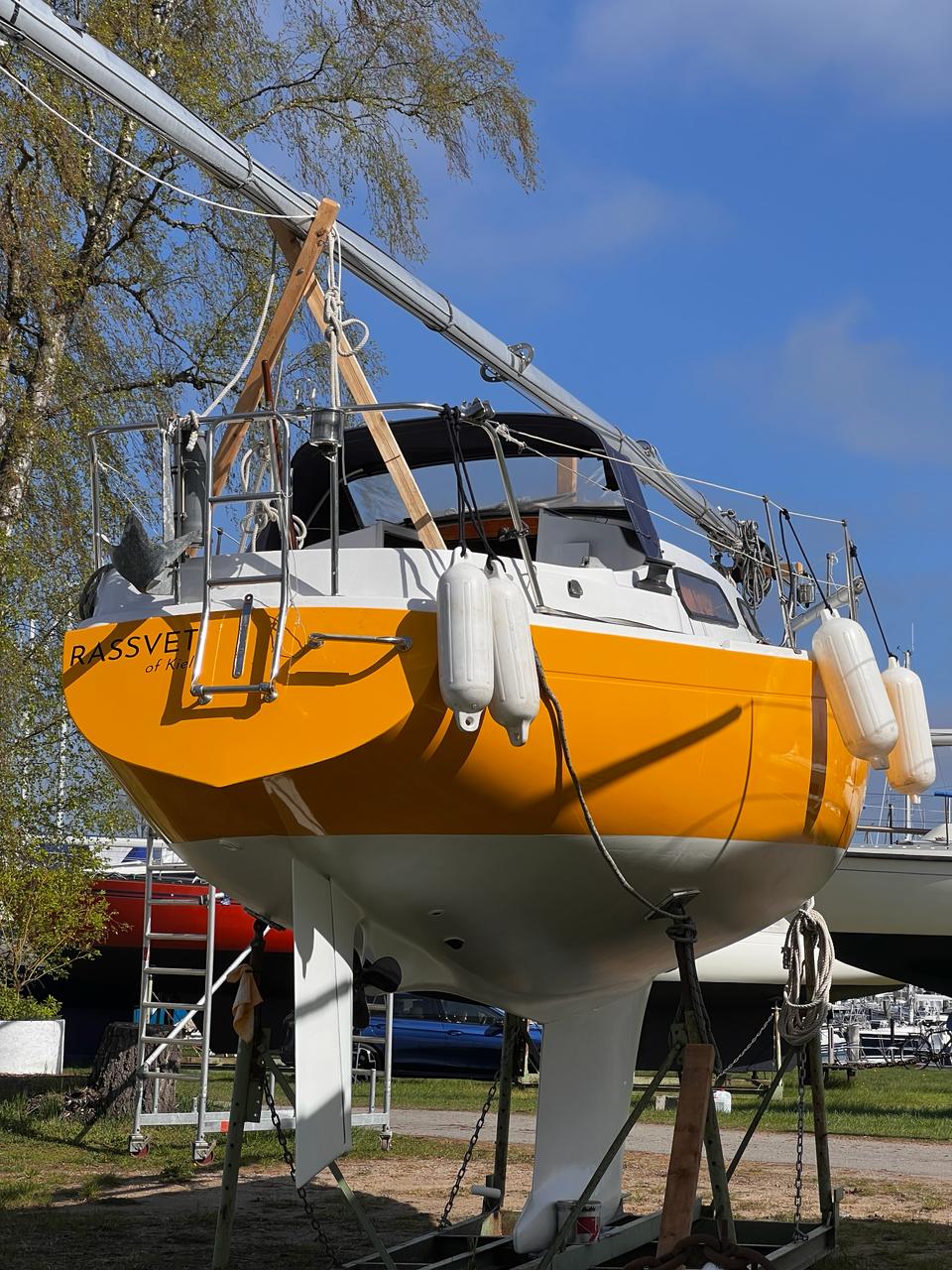
My yacht still had her original 1975 gelcoat, oxidised and aged, with a collection of chips and scratches exposing the fibreglass. Some were my own doing. I wanted to freshen her up and, above all, fulfil an old dream: a yellow yacht! Knowing the difficulties of two-part systems, I chose one-part paint, easier for an inexperienced sailor like me. Comparing Hempel, International and Epifanes, I chose the last simply because the guide was clearer.
Preparation
Made a shopping list and bought everything. As far as possible, repaired the gelcoat chips and scratches. Removed everything removable: locker lids, handles, locks, hatches. Masked off the underwater hull, wood and metal.
Sanding the gelcoat
First, connecting the sander to the vacuum. I felt old: for the first time in ages, I had to read the manual. I learnt to open that mysterious vent on the vacuum hose when sanding — a childhood mystery solved. Three days, over a hundred 320-grit discs, and an abrasive pad for awkward areas. I liked my new Makita BO5041. A neighbour let me try his Mirka: faster and more efficient, but the Makita’s side grip tired my arm less. I tried three disc types: denser material worked better, with ceramic-alumina discs best. Afterwards, washed with Hempel Pre-Clean and degreased with Epifanes Fibreglass Prep Cleaner.
Priming
The hardest stage, richest in mistakes. Every action brought difficulty. First, an untidy coat of Epifanes Multi Marine Primer left unevenness and runs. Sanding clogged discs quickly, formed lumps and scratched the surface. Degreasing with Epifanes Fibreglass Prep Cleaner rolled patches of primer into clay-like pieces. Instead of removing imperfections, I added more.
Painting
This knocked me completely off balance. I’d badly overestimated myself.
For three weeks, every Friday meant polishing with compound equivalent to 400-grit paper, while manually smoothing primer mistakes with the same grit. Nine in the morning to nine at night, then degreasing again with Epifanes Fibreglass Prep Cleaner.
Saturdays were white deck paint: the cabin area, coachroof and foredeck. Then onto the ladder for side decks and the coachroof sides. About one and a half 750ml tins of Epifanes Mono-urethane per coat.
Sundays were yellow topsides, again about one and a half tins per coat. Once, the tray fell — paint-side down, naturally. A good reminder to keep a spare tin and not pour everything into the tray at once.
My technique: roll on a strip, spread it across the surface with crossing strokes, then level the thickness with light horizontal strokes.
(Continued in the next post)
#maintenance
Original and discussionOpen post in Telegram ↗