The passage
To Kiel Canal: Kiel - Rendsburg
1 August 2025 began a new route into the North Sea towards the Wadden Islands. Marina neighbours said: ‘We don’t go there. Too dangerous.’But testing myself appealed more than listening to others’ fears. What is the Wadden Sea? The Wadden Sea is the shallows, sandbanks and islands along Denmark, Germany and the Netherlands. Everything changes by the hour: morning lagoon, desert by lunchtime. A subject of its own for sailors.
Stills from this chapter10 photos
Read the whole chapterCollapse chapter
1 August 2025 began a new route into the North Sea towards the Wadden Islands. Marina neighbours said: ‘We don’t go there. Too dangerous.’But testing myself appealed more than listening to others’ fears.
What is the Wadden Sea?
The Wadden Sea is the shallows, sandbanks and islands along Denmark, Germany and the Netherlands. Everything changes by the hour: morning lagoon, desert by lunchtime. A subject of its own for sailors. Channels open only with the tide; misjudge time or course, and you’re aground with a long wait for water, while waves pound the boat against the bottom. No wonder it’s UNESCO-listed: wild nature and a constantly moving sea make a unique combination.
First canal miles
At noon, out of Kiel. Canal operators on VHF twelve. Already my fifth lock transit this season; familiar, no surprises. Then towards Rendsburg where Konstantin would join that evening.
Twenty-five knots of headwind and rain seemed timed for the worst moments. But calm canal water allowed full speed. Green banks, gulls and cormorants overhead. Frequent fishermen to avoid; I kept wondering who had priority, motorboat or man with rod.
The blue-line town
To Rendsburg about twenty-one miles, five hours. A straight line on the map; rain on deck, woodland smells and passing ships in memory. Café, hot food, Konstantin arriving by bus from Hamburg.
That evening in Rendsburg a town of thirty thousand: old houses, bridges, waterfronts. A blue line through the centre leads past all the sights. Like following a chart route into the middle of history. A simple walk, but details make a place memorable.
#passage
Passage weather
The passage
Rendsburg - Gluckstadt
2 August 2025. Leaving Rendsburg at 7.30. Huge repair docks, then the transporter bridge. I wanted to see it work, but its light was red. Later, an odd change: emerald water became burgundy. Past halfway, it felt like the first sign of the North Sea approaching. Dense green vegetation against dark water looked striking. At the locks by two. Unlike the eastern end, two pairs here, for large and small vessels. About an hour’s wait. Green first: barges in.
Stills from this chapter10 photos
Read the whole chapterCollapse chapter
The Kiel Canal
2 August 2025. Leaving Rendsburg at 7.30. Huge repair docks, then the transporter bridge. I wanted to see it work, but its light was red.
Later, an odd change: emerald water became burgundy. Past halfway, it felt like the first sign of the North Sea approaching. Dense green vegetation against dark water looked striking.
At the locks by two. Unlike the eastern end, two pairs here, for large and small vessels. About an hour’s wait. Green first: barges in. Then white for yachts. The operator waits patiently for everyone before closing. At the far end, boats leave in order, first yacht first.
The Elbe
Straight out, a strong westerly hit. Low water, with the flood beginning east towards Hamburg. Waves to 1.5m. A hard welcome; no point fighting it directly. We went east with the stream. Genoa up, eight knots, rare for this hull. Evening arrival in Glückstadt.
Interesting berthing: current so strong, we stood still at low revs. Turned and ferry-glided almost by the textbook. Harbourmaster ashore: €12 a night. Fifty miles in ten hours.
An unexpected meeting
A Russian-speaking sailor on the next boat. His engine had died outside the canal; they’d berthed under sail. Awaiting a mechanic, he chatted. He’d wintered in Lübeck near my marina and repaired the saildrive. Something clicked: last winter, I’d recommended a workshop and nearby marinas to someone. I asked: ‘Is that your friend, by any chance?’ He nodded: ‘Yes, we sail together. He’s just left for Berlin.’Hard to believe for a second. The sea seems to arrange coincidences to remind us how small this circle is.
A town of good fortune
Glückstadt is small, cosy and historic. Founded in 1617 as a port for Hamburg it retains its old trading-town character: narrow streets, gabled houses, canals. Many business names begin with Glück, ‘happiness’ or ‘luck’. Waterfront, old centre, a park once the royal gardens. Dinner at the doner shop to finish.
Lessons
Tidal waters begin immediately outside the locks. Take them seriously: three- to four-knot streams, two-metre waves. Before leaving the canal, check forecast and tide tables, choose timing and destination. Lucky we thought to head for Glückstadt, but chance isn’t a plan in waters like these.
#passage
Passage weather
The passage
To Cuxhaven
3 August 2025. Left at nine, an hour before high water. Uncertain how long Cuxhaven would take with the streams. Twenty-five knots, two reefs in the main. North along the Elbe we could still sail. Like the Baltic prevailing winds are westerly. Ninety minutes later, the river bent west, wind dead ahead. Genoa furled, main and engine. Waves grew to a metre, each hitting the bow and slowing us to two knots. Impossible.
Stills from this chapter10 photos
Read the whole chapterCollapse chapter
Into the wind
3 August 2025. Left at nine, an hour before high water. Uncertain how long Cuxhaven would take with the streams. Twenty-five knots, two reefs in the main. North along the Elbe we could still sail. Like the Baltic prevailing winds are westerly.
Ninety minutes later, the river bent west, wind dead ahead. Genoa furled, main and engine. Waves grew to a metre, each hitting the bow and slowing us to two knots. Impossible. We began tacking under main and engine, between north cardinal marks guarding shallows and green buoys at the shipping-channel edge. Tacking usually doubles the distance, but speed quadrupled to 8.5 knots.
Under the sprayhood, watching wind, buoys and shipping. Kostya on the tiller, rain hammering the deck. Commands followed rapidly: ‘Left! More left! Hard right!’ At one point: ‘Turn left! Cargo ship coming at us!’ Kostya asked: ‘Why’s he coming here?’ Only a joke for an answer: ‘Because he wants to.’.
On like that to Cuxhaven. Sometimes churning, opposing streams turned the water sandy-coloured. All new. Last seen something similar in the Solent at the entrances to the Beaulieu River and Newtown Bay.
Thirty miles in five and a half hours.
Waiting out the storm
Plenty of marina space. €19 a night. The harbourmaster gives free beach tickets, normally paid. Also the last chance for bio-free diesel before the Wadden Sea.
Three days’ delay: across the North Sea came storm Floris, with sixty-knot winds near its centre. On MarineTraffic, I watched Grigory, who’d left when we did but headed for Norway. He sheltered north-east of Jutland. That prompted the idea of a Telegram bot showing friends’ yacht positions. Built most of it underway; finishing touches left.
Quiet, cosy town. Waterfront, beaches and cafés north; centre and shops south. Park walks, shells collected, wet feet in the sea. A castle-museum paper-art exhibition impressed me enough to buy its catalogue.
Ocean-weather forecasts
On 6 August, Windy showed 24 knots. Reef and leave? Even when wind eases, the sea takes time. Waves keep travelling for days, especially across unobstructed North Sea fetch. Looking only at wind is a mistake. Open the wave map and consider the previous day. Apparently manageable twenty knots can mean three-metre seas beyond boat or crew’s readiness.
Wave height exceeded the boat’s beam. Still dangerous, despite the moderate wind.
#passage
Passage weather
The passage
Into the High Seas: Helgoland
7 August 2025. We’d waited impatiently: after three days stuck in port, finally going to sea. Not an easy forecast: south-westerly to 24 knots, fighting it all the way. Offshore, currents rarely exceed 1.5 knots; near shore, three to five against you is possible. From Cuxhaven we needed the ebb, clearing fifteen miles of shoals before the flood. The difficulty was timing: first ebb at 1.46am, next only at 1.49pm. Leave before five to clear the Elbe in time.
Stills from this chapter9 photos · 1 video
Read the whole chapterCollapse chapter
Planning
7 August 2025. We’d waited impatiently: after three days stuck in port, finally going to sea. Not an easy forecast: south-westerly to 24 knots, fighting it all the way. Offshore, currents rarely exceed 1.5 knots; near shore, three to five against you is possible.
From Cuxhaven we needed the ebb, clearing fifteen miles of shoals before the flood. The difficulty was timing: first ebb at 1.46am, next only at 1.49pm. Leave before five to clear the Elbe in time. Approaching Heligoland was simpler: any time, without strong streams or drying marina approaches.
The passage
Cast off at 4.45. Fifteen miles by eight, a strict target. Unexpectedly, almost no wind, mirror sea. Engine on. Plotter 9.8 knots, log only five. Nearly ten over ground: a record for «Rassvet» . A pity the current, rather than the engine, deserved the credit.
At eight sharp, The Elbe was astern. Wind rose, waves to 1.5m, their crests clear on the depth sounder. Second reef in main, first in genoa. Fifteen miles on one tack, pressing hull and sails into the waves. Eventually, a lump in my throat, seasickness, attention reduced to simple acts: breathe deeply, wind on my face, hold the course.
Thirty-seven miles in seven hours.
The island
Heligoland appears suddenly: red rock growing from a grey-green horizon, a beacon from another world. A particular excitement approaching it. Once a British naval base, later transferred to Germany. Now a quiet resort with unique wildlife, no cars, sea smells and bird calls. After the waves, another rhythm of life.
Berthing
We approached Heligoland from the south. Downwind to furl the genoa, then head to wind to stow the main. Always an adventure in those waves. First, the southern harbour: forty-foot-plus yachts rafted two or three deep. Better try the north harbour for boats under ten metres. Right decision: plenty of space.
On «Rassvet» there’s no midships cleat, making a spring awkward. My solution: line from pontoon through the jib car, onto the winch and into the cleat. Convenient and reliable.
Payment only five to six in the evening, €30. Neighbours gave us facilities codes while we waited for the harbourmaster. Then off to explore.
#passage
Passage weather
Stopover
A day on Helgoland
Heligoland belonged to Britain in the nineteenth century as a naval base. In 1890, it was exchanged for German African colonies. A naval fortress in the Second World War; afterwards, the British tried to erase its defences. In 1947, 6,700 tonnes of explosives went into the rock. Operation Big Bang, Europe’s largest non-nuclear explosion. The island survived, leaving enormous craters on the plateau.
Stills from this chapter9 photos · 1 video
Read the whole chapterCollapse chapter
The Big Bang
Heligoland belonged to Britain in the nineteenth century as a naval base. In 1890, it was exchanged for German African colonies. A naval fortress in the Second World War; afterwards, the British tried to erase its defences. In 1947, 6,700 tonnes of explosives went into the rock. Operation Big Bang, Europe’s largest non-nuclear explosion. The island survived, leaving enormous craters on the plateau.
The North Sea’s red jewel
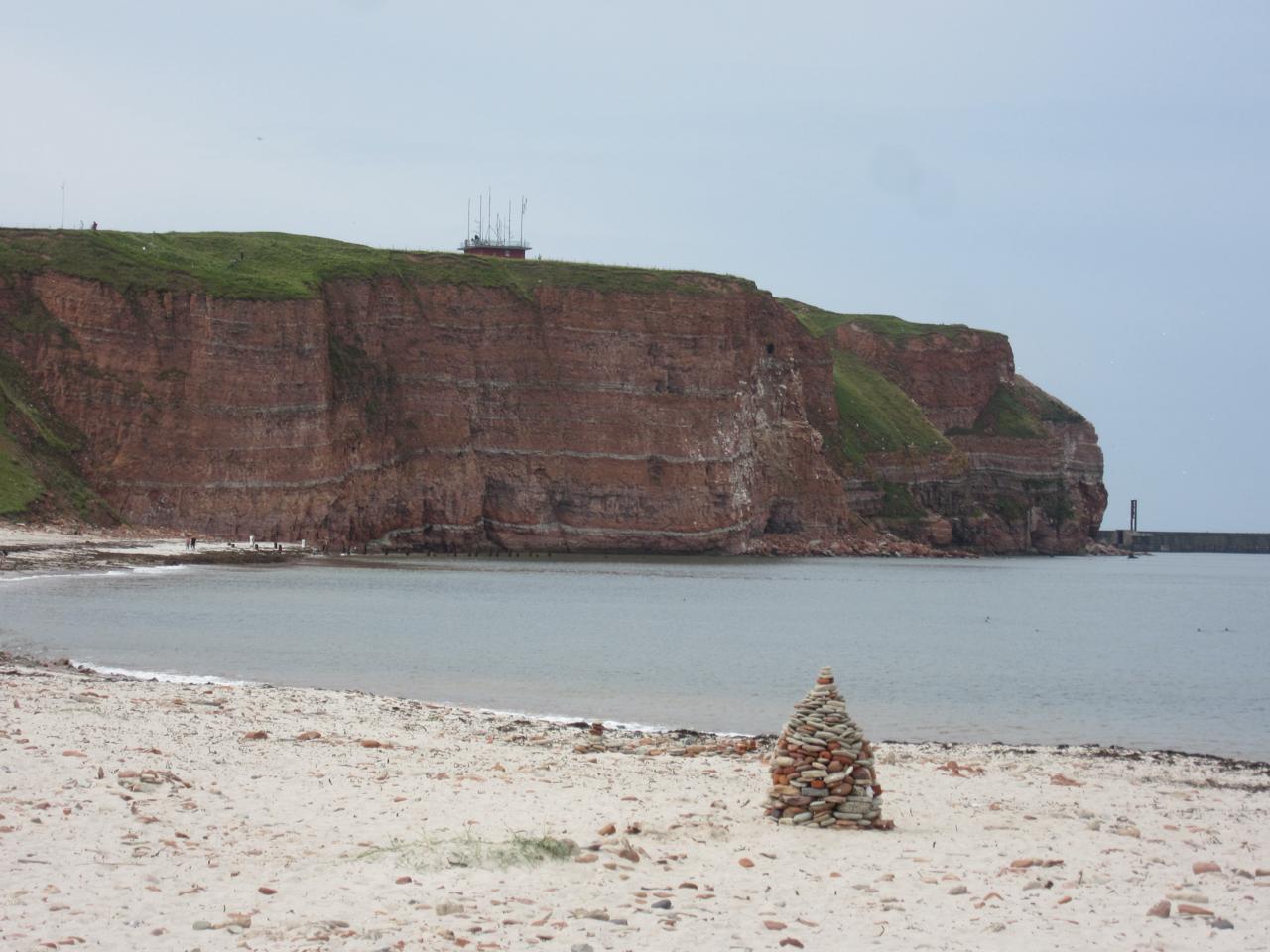
Straight after berthing, anticlockwise exploration. First, sandy beach and immense red-sandstone wall. Shoes off, as usual. People searching for something. I asked a woman: unique red flint. Gold fever caught us, eyes constantly on the ground.
Steps at the beach’s end led to green hills and a path. Ten minutes later, the northern tip and 47m sea stack Lange Anna, ‘Tall Anna’. Heligoland’s symbol, loved by tourists and birds.
One of northern Europe’s important migrant-bird sites: hundreds of thousands stop in autumn between Siberia and Africa. Even August buzzed with life. Gannet colonies on the west coast: large birds, up to 100km/h in flight and forty-metre dives for fish. So many, you could reach out and touch them.
The town
Beyond the lighthouse, narrow streets and northern German houses. Quiet, broken only by gulls and surf. Cars banned by law. Then endless shops and restaurants. Duty-free Heligoland: prices nineteen per cent lower, with ferries still bringing Hamburg visitors for alcohol and cigarettes.
A schoolgirl sold red-flint stones by the road, alone but determined. My feet stopped of their own accord; a minute later, a three-euro stone was in my pocket.
Düne
A five-minute evening ferry to Düne, the neighbouring sandy island that constantly changes shape. No permanent residents, only beaches, cafés and parasol hire. An unexpected encounter ended the walk: seals resting on the beach, lazily watching without moving. A rare closeness to wildlife that makes falling in love with the place inevitable.
An unpleasant surprise
A little fuck-up too. I often use foot warmers on passages. One tore while berthing, scattering sand-like contents on deck. Seemed trivial. Later, rust stains appeared: the ‘sand’ was iron powder, immediately ingrained in the paint. Water wouldn’t shift it. A job for Kiel.
#passage
The passage
To Wangerooge Island
8 August 2025. Force 5, south-south-west. The Frisian islands all lay south-west, while the morning flood would carry us east. A TSS to cross too. Not a simple passage. Wangerooge, thirty miles south, was the target. Anything farther west was unreachable. Sail as close as possible. Navily reviews gave an entry window two hours either side of high water, 12.04. At five knots, leave at six. But tacking would add distance, and sleep was needed.
Stills from this chapter9 photos · 1 video
Read the whole chapterCollapse chapter
Planning and departure
8 August 2025. Force 5, south-south-west. The Frisian islands all lay south-west, while the morning flood would carry us east. A TSS to cross too. Not a simple passage.
Wangerooge, thirty miles south, was the target. Anything farther west was unreachable. Sail as close as possible. Navily reviews gave an entry window two hours either side of high water, 12.04. At five knots, leave at six. But tacking would add distance, and sleep was needed. We left Heligoland at 4.40am.
The passage
Bright sunrise. Wind to 24 knots, two reefs in main, one in genoa. Waves 1.5m, heel thirty degrees. Six knots: Wangerooge began to feel possible. GPS supported the hope.
But the stream strengthened and carried us increasingly east. Engine on to point higher.
The approach
At eleven, the entrance appeared. Autopilot off, hand steering, following lateral marks. Beyond the sandbar, I gave Kolya the tiller and dealt with the main. Branches marked the marina route: twigs upwards, red side; downwards, green. A seal swam calmly past.
Full marina. A man on the pontoon waved arrivals into place. Five minutes later, he pointed us alongside another boat. A third rafted beside us later, and we chatted with her owner.
Wadden secrets
He rarely went into the North Sea. Between mainland and islands lay a whole other world, the Wadden Sea. Travel only with the tide, but almost no waves or strong wind. A special yacht, though: under ninety centimetres draught and external keel cooling, or sandy water clogs the engine. Built in the Netherlands.
Water below
Below, a wet carpet. A chill: the flooding story was too recent. Taste: salty. Water under both berths. While I pumped, Kostya searched. The stern-tube seal: a thin stream into the engine compartment. Heeling stopped the pump catching everything; some overflowed below. No repair here. Watch the level, replace the seal in winter. First, avoid sinking.
The moving island
€22 overnight. Two toilets, two unlimited showers. Five kilometres to town, walking or on a hired bike; alternatively, a little train from the port. No cars.
Wangerooge seemed endless fields with three lighthouses. The oldest, nineteenth-century brick, is now a lookout and wedding venue.
Lovely paths. Hares grazed beside us, unconcerned. A local detail: storms erode the west and deposit sand east. The island never stays still; it moves.
#passage
Passage weather
The passage
Wangerooge - Norderney
9 August 2025. All thirty litres from the cans had gone into the forty-litre tank yesterday. Refuelling soon, then. Left at ten, three hours before high water. Boats on both sides made departure difficult. We pulled back on a line to angle the stern forty-five degrees. Thankfully, neighbours helped. Along the banks Between Wangerooge and Spiekeroog, depths fall to half a metre. Chart and buoys don’t always agree. Carefully along the red marks, then safely offshore.
Stills from this chapter8 photos
Read the whole chapterCollapse chapter
The fuel question
9 August 2025. All thirty litres from the cans had gone into the forty-litre tank yesterday. Refuelling soon, then.
Left at ten, three hours before high water. Boats on both sides made departure difficult. We pulled back on a line to angle the stern forty-five degrees. Thankfully, neighbours helped.
Along the banks
Between Wangerooge and Spiekeroog, depths fall to half a metre. Chart and buoys don’t always agree. Carefully along the red marks, then safely offshore. Light south-westerly, clear sky. Motor-sailing, course set, autopilot on, shirts off in the cockpit.
Minimum goal Spiekeroog, maximum Norderney. Constant checks of speed, ETA and tide tables. Norderney looked reachable. A quiet passage: one island astern, another ahead, again and again.
Thirty-one miles in six and a half hours.
Arrival and the diesel dilemma
Norderney’s jobs: diesel, water, route. €20 berth. Fuel? The harbourmaster said cans only, B7 only — biofuel blend. Not what I wanted.
Rolls and water at Edeka’s tables. Google Maps, ChatGPT, Navionics open. The last bio-free diesel was Cuxhaven; nearest GTL, gas-to-liquid, Lauwersoog in the Netherlands.
Back aboard, neighbours offered a gift of advice: enter via Delfzijl, pass Groningen, emerge at Lauwersoog. Possible in a day, mast up, no concern about wind in the canals. Inspiring: canals had long been a dream. Just a red-white-blue courtesy flag needed. The harbourmaster had one, €5. The Netherlands it would be!
Town and festival
Evening promenade. Dozens of hares in a field, horses grazing with more hares round their legs. A funny sight. Wine festival in the centre, welcome German sausages. Sunset along the waterfront: cafés, restaurants, easy festive bustle. Cosy.
East Frisian tea
I bought rock sugar, a local speciality. East Frisia has a famous tea culture. Legend says Hitler tried switching Germany to coffee, but the Frisians protested so fiercely he left them alone. True or not, an interesting story.
The ritual: strong Assam and Darjeeling, poured over rock sugar in the cup, a layer of cream gently added. Never stir. Drink the layers: cream, bitter tea, sweetness. Above all, three cups. Frisians accept no fewer.
#passage
Passage weather
The passage
To the Netherlands: Lauersog
10 August 2025. Left at the start of the ebb, 7.13am. Navionics showed 1.5m over the bank between the islands, less than my draught. I hoped for at least another metre of water by arrival. At the bank, north-westerly eighteen knots, waves 1.5m, watched on the sounder. All attention on the numbers: twice, only ninety centimetres beneath the keel. Through, I could breathe and send Kostya for more sleep.
Stills from this chapter8 photos · 2 videos
Read the whole chapterCollapse chapter
A dangerous sandbank
10 August 2025. Left at the start of the ebb, 7.13am. Navionics showed 1.5m over the bank between the islands, less than my draught. I hoped for at least another metre of water by arrival.
At the bank, north-westerly eighteen knots, waves 1.5m, watched on the sounder. All attention on the numbers: twice, only ninety centimetres beneath the keel. Through, I could breathe and send Kostya for more sleep.
Towards the Netherlands
I wanted Lauwersoog directly, without turning into the Ems or Delfzijl. North to the TSS, then a course for Schiermonnikoog. For three hours, the angle wouldn’t work: only seven miles towards our destination. On the second attempt, the angle came right. We could sail straight to the Netherlands.
Kostya returned. I gave him the course and lookout, and for the first time let myself rest at sea. Usually always on watch, I trusted the boat and went below for an hour. Odd feelings: creaking, motion, noise, no sense of safety. Sleep came anyway. Back out as we passed a wind farm.
Approaching Schiermonnikoog
Near shore, sails furled, engine on. The flood was just beginning, depths changing. Eyes on the sounder again. The chart explicitly warned that depths were variable and caution needed.
At nine, outside the lock. Seventy miles, fourteen hours. Tried VHF, phone, gate button, even climbed to the cabin. Nothing. We rafted beside a yacht at the nearby marina instead.
A Dutch discovery
Our Dutch neighbour was friendly and funny. I complained about the lock. He recommended Waterkaarten: inland-waterway charts across Europe. Enter boat dimensions and it routes for bridges and locks, each with opening hours, VHF and phone. Installed, registered: a real key to Dutch canals. Fixed hours, usually seven to seven.
First Dutch night
No harbourmaster. €23 through Blue Water App, then facilities code on screen. Plenty of showers and toilets, unlimited water and power. After the long day, a hot shower felt luxurious. At last, an undisturbed night’s sleep.
#passage
Passage weather
Channels
By canals to Groningen
11 August 2025. Quiet weather, ambitious plan: across the Netherlands by canal in a day. At 7.50, the lock gates were open for us. In, mooring lines to hanging ropes, an easy transit. Then Noordergat marina: thirty litres into cans, fifteen into the tank, €2.12 a litre. Enough for Germany. Canals and bridges Straight river-like canals, thirty to fifty metres wide, up to five deep. Almost no wind, sunshine, endless fields with cows and sheep.
Stills from this chapter8 photos · 2 videos
Read the whole chapterCollapse chapter
First locks and fuel
11 August 2025. Quiet weather, ambitious plan: across the Netherlands by canal in a day. At 7.50, the lock gates were open for us. In, mooring lines to hanging ropes, an easy transit.
Then Noordergat marina: thirty litres into cans, fifteen into the tank, €2.12 a litre. Enough for Germany.
Canals and bridges
Straight river-like canals, thirty to fifty metres wide, up to five deep. Almost no wind, sunshine, endless fields with cows and sheep. Without opening bridges, rather dull.
Bridges enlivened it. Initially, full formal radio calls. Then I noticed one operator controlled several. Shortened to: ‘Bridge [name], may I pass?’ Just as effective.
Tried the call buttons too, directly alerting the operator. The real discovery: do nothing. Approach and wait; they see you and open. Slight guilt at stopping all the traffic for our little boat. Sometimes opening seemed to begin before we rounded the bend.
Eighteen bridges and two locks, all three methods tested. Entirely free.
Groningen
Reached Groningen at 2.30, needing to pass before the 3.30 bridge-opening break. Special canal: historic houses, long barges converted to homes with power and drainage. I’d thought that happened only in Amsterdam. Same here, without tourists.
Looking around, a childhood dream fulfilled: taking a boat through the heart of a city among people, houses and bridges.
Unexpected stop
A bridge in the centre stopped us. Waited, no movement. Called: no opening today. Phoned for details using Waterkaarten’s number. A festival had closed it. No alternative with the mast up. Disappointed: a week fighting our way here with what should have been following wind, and now we’d wait until it turned easterly and face headwinds again.
Berthed under trees at the town quay. Twenty-seven miles, seven and a half hours.
Evening in town
The delay was a gift, honestly. After fields and canals, Groningen felt festive. Wandering streets and shops, cheese with a lingering nutty flavour. Bicycle bells everywhere, café laughter, music reflecting in canal water with the lights. Easy and carefree. A feeling of comfort and freedom I wanted to take away.
#passage
Passage weather
The passage
Sea again: Borkum
12 August 2025. An ideal plan: leave Groningen at 9.30, cover twenty-four canal miles to Delfzijl by 3.06, when flood turned to ebb. Then thirteen Ems miles with following stream and easterly wind. Almost a textbook exercise. Left at 9.50. First test, yesterday’s closed bridge. Phoned; wait. Half an hour later, a woman with a bag reached the control hut and raised it. We wished her a good day.
Stills from this chapter7 photos · 3 videos
Read the whole chapterCollapse chapter
Heading back
12 August 2025. An ideal plan: leave Groningen at 9.30, cover twenty-four canal miles to Delfzijl by 3.06, when flood turned to ebb. Then thirteen Ems miles with following stream and easterly wind. Almost a textbook exercise.
Left at 9.50. First test, yesterday’s closed bridge. Phoned; wait. Half an hour later, a woman with a bag reached the control hut and raised it. We wished her a good day. Leaving town, an enormous ten-lane road bridge stopped all traffic for our nine-metre yacht, huge spans rising. The Netherlands respects its waterways.
A lesson from a barge
Twelve bridges behind, Delfzijl lock ahead. A barge entered first. I drifted outside while she berthed, then followed when things looked settled. Suddenly, she engaged her engine. Churning water flung us at the wall like a toy. All I could shout was ‘Oh God!’, before the crash.
Two women came from ashore to check us. They explained we should have waited for the next lock cycle rather than followed the barge. They suggested we leave first to avoid her prop wash again. Very welcome advice.
At the pontoon, damage inspection. Topside scratches, easily sanded and painted. A chip at the bow, repairable with filler. The pulpit fared worse: bent forty centimetres, almost torn out. It apparently absorbed the blow and saved the hull. Remove, straighten, reinforce the mounts. Most importantly, the hull was sound.
The Ems
Sail up, northwards. Little wind, engine added. Quiet until the turn into Borkum’s fairway. Headwind and strong current: two knots, full engine, boat pitching, hard to hold course. Zigzags to stay within the channel, shoals beside us, motorboats passing with wash. A cocktail of stress.
Main lesson: enter here only with a favourable stream.
Evening ashore
Rafted alongside a yacht. Town five kilometres away; no energy left. A shore walk, wild hares, then buckwheat and tinned meat: food tested by storms and locks. Shower, instant sleep. An eventful day.
#passage
Passage weather
The passage
Borkum - Spiekero
13 August 2025. About fifty miles Borkum–Spiekeroog, ten hours. Main difficulty: the entrance sandbar, only twenty centimetres charted, exposed at spring low water. High tide adds 3.5m. High water 3.29pm, so leave by six to avoid fighting the ebb. Borkum’s depths permit departure anytime; flood not until 8.39. Light easterly, five to seven knots. Engine needed, sail mainly for stability. The passage More fishing boats than I’d seen anywhere.
Stills from this chapter9 photos · 1 video
Read the whole chapterCollapse chapter
Planning
13 August 2025. About fifty miles Borkum–Spiekeroog, ten hours. Main difficulty: the entrance sandbar, only twenty centimetres charted, exposed at spring low water. High tide adds 3.5m. High water 3.29pm, so leave by six to avoid fighting the ebb. Borkum’s depths permit departure anytime; flood not until 8.39.
Light easterly, five to seven knots. Engine needed, sail mainly for stability.
The passage
More fishing boats than I’d seen anywhere. Salt surprised me too: white film over the whole deck, like flour. Otherwise quiet: light wind, almost no waves.
Near Spiekeroog, a cinematic moment. I went to the mast to lower sail, Kostya at the tiller. As the last cloth dropped, a fishing vessel appeared straight ahead, only three hundred metres away. Nets out on both sides, gulls astern. ‘Kostya! Turn! Quickly!’ Confusion first, then he moved the tiller in time. About fifty metres between us. Thankfully, no net in the propeller. The fishermen neither turned nor slowed. Kings of the sea indeed. Lucky to escape consequences.
Spiekeroog
Plenty of marina space. Berthed quietly, €21 paid, off to explore.
A beautifully kept resort island. Named houses, flowers in windows, neat streets, cafés, restaurants and shops. Beyond town, dunes and the sculpture De Utkieker — ‘The Watcher’ — with wonderful views over the tidal flats. Then broad beaches and dunes, lovely barefoot. Only the second stop after Heligoland I’d call truly beautiful.
A Wadden surprise
Back at the boat, astonishment: almost no water left. Yachts stood in mud among puddles, even the quay base exposed. Never seen a marina vanish with its water.
Atmosphere
More than beauty: meadow scents filled the air, like walking through a vast natural apothecary. Almost healing, easing fatigue and the day’s tension. A magnificent end to the East Frisian islands. Worth returning for longer.
#passage
Passage weather
The passage
Return trip to Cuxhaven
14 August 2025. Precision needed leaving Spiekeroog: at low water, a sandbank links it to Langeoog. High water 4.04am. For a little more sleep, departure at five, clear of the shoal by 6.30 or risk a hard grounding. Destination Büsum. Descriptions said its lock opened with at least a metre of tide and no strong southerly. At 5.07pm, three metres of tide, north-westerly nine knots. Ideal. Into darkness Pitch black, like floating in space.
Stills from this chapter8 photos · 2 videos
Read the whole chapterCollapse chapter
Planning
14 August 2025. Precision needed leaving Spiekeroog: at low water, a sandbank links it to Langeoog. High water 4.04am. For a little more sleep, departure at five, clear of the shoal by 6.30 or risk a hard grounding. Destination Büsum. Descriptions said its lock opened with at least a metre of tide and no strong southerly. At 5.07pm, three metres of tide, north-westerly nine knots. Ideal.
Into darkness
Pitch black, like floating in space. Kolya’s torch picked out branches marking the fairway edges. He called from the bow; I followed our recorded track, anxiously checking depth. No lights or reflections, just black water.
No wind, engine on. Current carried us at 7.5 knots. Offshore by six, towards Büsum, among yachts, fishing boats and container ships. Altostratus formed an endless grey dome.
Meeting a front
Halfway, clouds lowered: usually an approaching front. Nothing forecast; no internet left to check. Wind eight, twelve, eighteen knots. Genoa up, engine off. Nearer Büsum’s channel, the wind shifted more. A couple of miles out, north-easterly 28 knots, two-metre waves.
Furled to the second reef, headed north to turn into the fairway from the east. Worse: buoys disagreed with the chart, wind knocked us off course, sea boiled. Requested an inReach forecast update. Still nine knots, as though the storm existed only for us.
With the same conditions tomorrow, we couldn’t leave Büsum. Better not risk it. Divert to Cuxhaven.
Turning towards shelter
A couple of hours later, wind eased, clouds gone, sun out as if nothing had happened. Smooth sea; the storm seemed a dream. Engine pulled strongly. Cuxhaven at five: sixty-two miles, twelve hours.
Evening in town
A waterfront walk released the tension. Setting sun turned the water into fine threads of light. Cruise ship AIDAb appeared, ablaze in colours, a floating city passing the wooden Kugelbake navigation mark. Here since the eighteenth century, once the Elbe entrance’s essential landmark, now Cuxhaven’s symbol. I stood beneath it awhile, then slowly returned aboard.
#passage
Passage weather
The passage
Across the canal back to Kiel
15 August 2025. A rare chance to rise after sunrise: the flood began only at 11.14. Light westerly, sunshine. Fuel berth at noon, tank full, facilities card returned, Elbe at one. Through the lock The stream whisked us towards Brunsbüttel. Ideal: three hours to the Kiel Canal lock. VHF thirteen for instructions, turned against the three-knot stream to wait. Throttle needed to stand still. Fifteen minutes later, gates open, a column of boats emerged.
Stills from this chapter10 photos
Read the whole chapterCollapse chapter
Planning
15 August 2025. A rare chance to rise after sunrise: the flood began only at 11.14. Light westerly, sunshine. Fuel berth at noon, tank full, facilities card returned, Elbe at one.
Through the lock
The stream whisked us towards Brunsbüttel. Ideal: three hours to the Kiel Canal lock. VHF thirteen for instructions, turned against the three-knot stream to wait. Throttle needed to stand still. Fifteen minutes later, gates open, a column of boats emerged. White light; more throttle, barely moving. I worried we’d stay there until the stream eased. Thankfully, the operator waited. Slowly but surely, inside.
Behind us, a Norwegian sailor on his first transit. He’d done the Rolex Fastnet Race, the famous race along England’s south coast. Hull impact, lost gennaker, torn genoa and main: €20,000 damage. ‘First and last time.’ Understandable. Now home to Norway via the Baltic, avoiding another North Sea storm.
Gates open, goodbyes, onward.
Canal quiet
Peace inside. Half an hour earlier, fighting current at the limits; now another world. Breathing and lapping water, sunset turning the sky gold. The background tension switched off. No more battling the elements, it seemed.
Almost a hundred kilometres of calm water, daylight navigation only. Five overnight stops, kilometres one, twenty-one, forty-one, sixty-six and eighty-five. We could reach forty-one, the pontoon by old Gieselau lock. The day total: thirty-eight miles, eight hours.
Next morning
Quiet progress until Kiel-Holtenau lock, already containing two container ships. The first kept her engine running, strong prop wash astern.
I approached the pontoon carefully. Kolya secured the bow, but when I handed him the stern line, he released the first and ran aft. We swung perpendicular to the wall. Fatigue showing. Thankfully, enough line length to avoid starting again.
The boat behind had it worse, directly in the prop wash. Eight fenders over, five people pushing with all their strength to avoid being crushed into the pontoon. Like that until the gates opened.
The end
Another thirty-one miles, seven hours, and Kiel. Tired, but a full stop at the end of a long chapter. Even quiet passages find surprises: a line mishandled, a container ship giving neighbours a whirlpool treatment. The sea reminds you: relax after berthing.
#passage
Passage weather
Afterword
What's left after the trip
Leaving Kiel in early August, I expected the North Sea to toughen me up, test decisions and bring strong wind and high waves. It did. Long planning sessions daily: wind, waves, currents, tide tables. No room for mistakes, no refuges or anchorages nearby. After a week, checking data and calculating ideal departure and arrival times felt automatic. Waves, currents and fishermen The North Sea always moves.
Stills from this chapter10 photos
Read the whole chapterCollapse chapter
Expectations
Leaving Kiel in early August, I expected the North Sea to toughen me up, test decisions and bring strong wind and high waves. It did. Long planning sessions daily: wind, waves, currents, tide tables. No room for mistakes, no refuges or anchorages nearby.
After a week, checking data and calculating ideal departure and arrival times felt automatic.
Waves, currents and fishermen
The North Sea always moves. Waves don’t appear or disappear; they simply exist, endless day-and-night breathing. Add five-knot streams, turning steady progress into fighting for metres. Shoals everywhere. Fishermen the local kings: straight at you, nets either side, gulls behind, without fuss.
And remarkable variety: first red cliffs at Heligoland, tacking up the Elbe, a Wangerooge seal, Norderney hares, Groningen at sunset like a living stage set.
Fuck-ups and lessons
• The stern-tube seal at Wangerooge developed its own personality as an onboard fountain. A modification that still makes me nervous about going to sea.
• Delfzijl lock taught us not to enter a confined space with a barge. Price: the pulpit bent and torn from its starboard mounts.
• A fishing vessel off Spiekeroog showed how a sail blocks your view at the worst moment.
• Büsum’s fairway and the wind ‘only we experienced’ reminded us forecasts are theory. Learn to read clouds and pressure like a book.
• Kiel Canal berthing gave us classic fatigue: one line secured, then dropped while running for another. Lucky the lines were long enough.
• Waves tore out the heads mounting and broke the saloon door. It now closes by persuasion rather than hand.
• A burst heat pad rust-stained the hull; every mistake added a scratch. The sea dislikes smooth surfaces.
New skills
• Waterkaarten, locks and opening bridges mastered. No mysteries left.
• Real-world tidal planning. Tables, charts and clocks became daily routine.
• Tested the boat, from a lock-wall impact to settling into Spiekeroog mud.
Feelings
Fear stopped my heart at the lock wall or while being swept sideways in the Ems. Joy opened it at gulls over fishermen or the meadow scent of Spiekeroog. And a childhood dream fulfilled: my own boat through a city’s heart.
The finish
Just over five hundred miles in two weeks, dozens of bridges and locks, calm and squalls, towns you’d never otherwise reach. Beyond the familiar Baltic into a world where each tide matters more than engine or chart.
Sometimes frightening, sometimes funny, mostly beautiful. Two weeks became a story impossible to forget.
#passage