In this publication5 photos · 5 videos
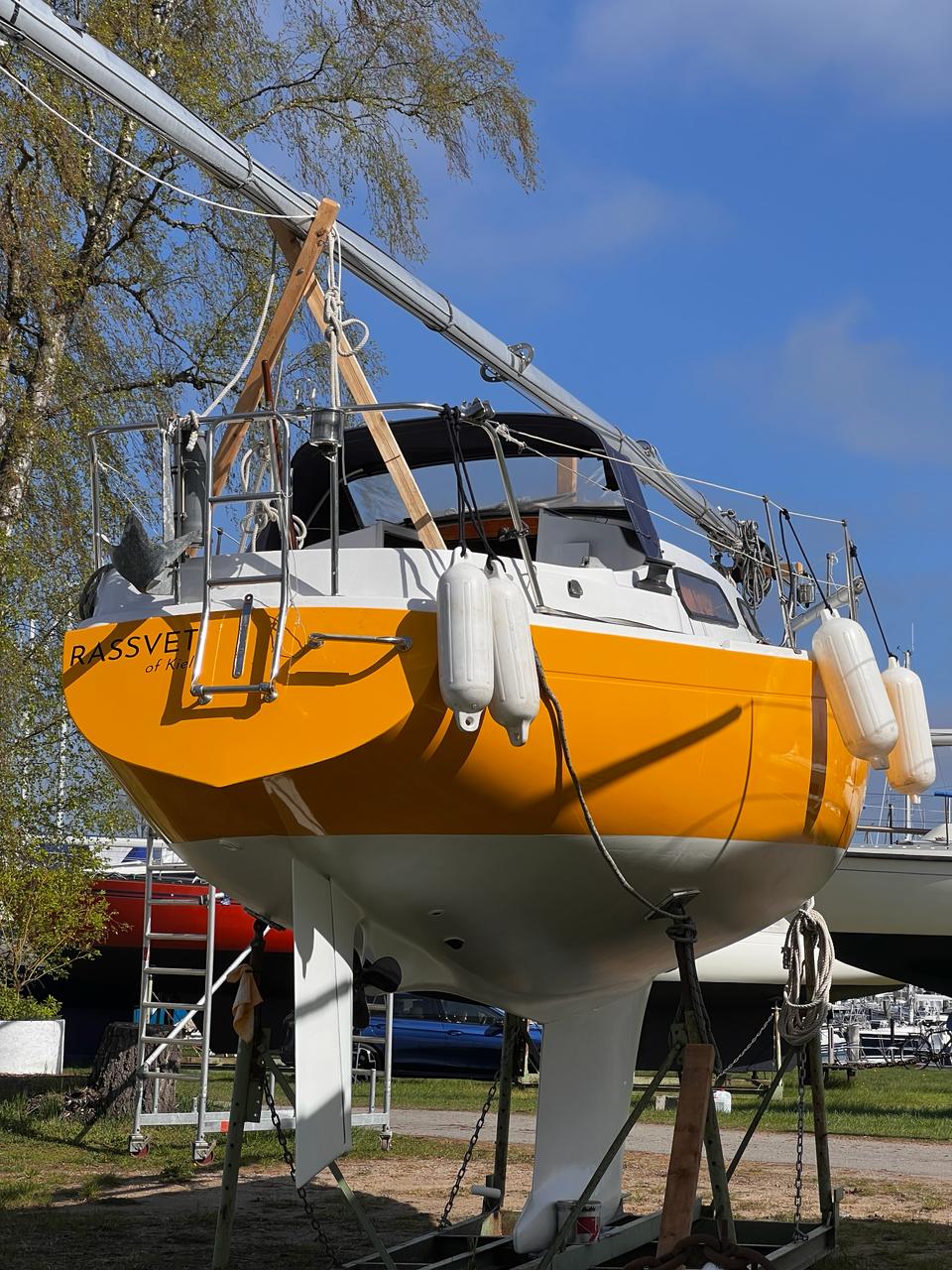
The first job for the new season was sanding below the waterline. I bought:
— a budget Bosch sander for €50 and 25 discs of 80-grit paper
— masking tape
— plastic sheeting
— a headtorch
— protective suit, mask, goggles and gloves
First, I masked the waterline. I’d barely started before the neighbours stopped me: could I enclose the boat somehow? They didn’t want to choke on dust. Fair enough. At the nearest Bauhaus, I found 25m × 2.5m sheeting with a built-in strip of masking tape.
Sanding was slow, hard work, perhaps because of the cheap machine. About fifteen hours and as many discs. The dust cloud was so thick I could barely see my fingertips at arm’s length. The main aim was removing yellow barnacle marks from the paint. In places, I reached the primer. I sanded the propeller blades back to metal. For tight spaces, I also bought a Black & Decker belt sander for €52.
The worst part was fogging goggles. Ten seconds, and everything disappeared into mist. I needed something to leave an anti-condensation film. I considered oil or Fairy washing-up liquid. The Fairy worked perfectly.
What I missed: first, put plastic sheeting under the boat. Sweeping up the dust took over an hour. Second, the dust is nasty and gets through the mask. Washing it off my face and hands, it rolled into sticky clay. In Grigory’s comments I saw advice to wet-sand instead. Some neighbours had sanding machines that extracted the dust straight into a water-filled drum.
Why bother? Barnacles happily settle on every irregularity. Too many paint layers can also flake away, exposing the laminate and potentially leading to osmosis. Some people don’t bother, as the final photograph of a neighbouring yacht shows.
#maintenance
Original and discussionOpen post in Telegram ↗