September 14
First day and distribution of responsibilities
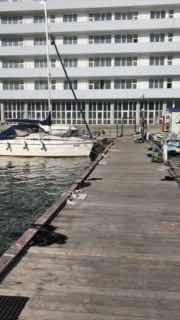
The practical part of my IYT Bareboat Skipper course at Black Sea School began on 14 September 2021. After I paid the deposit, they emailed everything I needed to know, from what clothes to bring to local taxi numbers. You can leave your bag at the office, and there are cafés with inexpensive set lunches in nearby Victory Park. At 3.30pm, they gathered us together and split us into two groups: those with experience and those without.
Stills from this chapter1 video
Read the whole chapterCollapse chapter
You can leave your bag at the office, and there are cafés with inexpensive set lunches in nearby Victory Park.
At 3.30pm, they gathered us together and split us into two groups: those with experience and those without.
We sat in the cockpit and introduced ourselves: where we were from, what we did, our sailing experience and what we planned to do with the qualification. There were seven of us. Nikolai and I were from the Moscow region; Igor, from the Leningrad region; Alexei and Vyacheslav, from the Saratov region; one Sergei, from Khabarovsk; and the other, from Kamchatka.
Our instructor was Denis Mironov. He appointed a treasurer, first mate and bosun. We paid for lunches and drew up a duty rota covering galley help, filling the water tanks and cleaning the yacht.
Denis showed us how to use the heads, shower and gas cooker. For the evening, he told us to revise the flashcards on the International Code of Signals and yacht rigging.
#training #bss
September 15
Exercises in the marina
The next morning, breakfast arrived: fruit and curd cheese bake, with bread, sausage and cheese. After that, we decided to stop paying for breakfasts. Our instructor Alexander arrived, tested us on yesterday’s flashcards, and handed out yacht handover checklists. They help protect you against claims from the charter company and show you where everything is kept on board.
Stills from this chapter1 video
Read the whole chapterCollapse chapter
Our instructor Alexander arrived, tested us on yesterday’s flashcards, and handed out yacht handover checklists. They help protect you against claims from the charter company and show you where everything is kept on board.
Lunch was a fresh vegetable salad, borscht with sour cream, buckwheat with chicken, bread and fruit compote.
After a rest, we looked at lifejackets: the bulky foam ‘bricks’ for abandoning ship and the automatic inflatable ones for everyday use. On the pontoon, we coiled mooring lines in circles and figures of eight, then practised throwing them up to eight metres. Back on board, we timed ourselves tying clove hitches — five seconds per fender — and made a covering of knotwork around a long length of rope. Finally, we paired up to practise handling mooring lines on the stern, midships and bow cleats, giving the appropriate commands.
That evening’s homework was knots: the figure of eight, Flemish bend, and a quick way of tying a bowline.
A full day. We went to the main waterfront for dinner.
#training #bss
September 16
First training passage
On day three, Yulia, the wife of Sergei from Khabarovsk, made us all omelettes. We bought cheese, bacon and sausages at the nearest shop and brewed coffee in a flask. After eating, we practised knots until Sasha arrived. We began with the inboard engine: listened to the briefing, checked the oil and cooling system, started it, tried the engine control positions, and shut it down. For the practical session, we cast off and went out into the bay.
Stills from this chapter1 video
Read the whole chapterCollapse chapter
We began with the inboard engine: listened to the briefing, checked the oil and cooling system, started it, tried the engine control positions, and shut it down.
For the practical session, we cast off and went out into the bay. The idea was to get a feel for how the yacht handled. We took turns at the wheel, going ahead and astern and following helm and course orders, such as ‘135 degrees to starboard’ or ‘Steer south-west’.
We returned for lunch: meatball soup, Greek salad, pilaf and fruit compote.
Then back out on the water. This time, we had to steer figures of eight between two mooring buoys, keeping a steady turning radius with the buoy abeam: twice going ahead, once astern. We finished by approaching a buoy stern-first as if berthing against it, then handed the wheel to the next person.
We had dinner on the yacht.
#training #bss
Passage weather
September 17
Practice continues
Denis returned in place of Sasha. With him, we each practised the approach for stern-to berthing three times, then completed one full berthing and departure manoeuvre. The difference in approach was immediately obvious: Denis supervised more closely. On the one hand, our manoeuvres improved; on the other, we had less chance to feel what the boat was doing.
Stills from this chapter1 video
Read the whole chapterCollapse chapter
Denis returned in place of Sasha. With him, we each practised the approach for stern-to berthing three times, then completed one full berthing and departure manoeuvre. The difference in approach was immediately obvious: Denis supervised more closely. On the one hand, our manoeuvres improved; on the other, we had less chance to feel what the boat was doing.
Lunch was mushroom soup with sour cream, a salad of cucumber, tomato and herbs, and pearl barley with a meat patty.
After lunch, we practised coming alongside. Easier than stern-to, but there were details to remember — taking your reference from the bow cleat rather than the bow itself, for example. We each had three goes.
For dinner, we went to the nearby Oranzhereya restaurant. They had lovely pink lemonade.
Back on the yacht, we studied the COLREGs flashcards.
#training #bss
Passage weather
September 18
Stormy Day and Theory
Day five. Breakfast was buckwheat and a sausage. We revised yesterday’s flashcards and tried the practice test for the online theory course. Denis turned the flashcards into a game. We drew them from the deck in turn and gave an answer. If you couldn’t answer, you kept the card in front of you. Whoever had the biggest pile would have to polish the ship’s bell. We finished with an empty table. Bad weather made it a navigation day.
Stills from this chapter1 video
Read the whole chapterCollapse chapter
Denis turned the flashcards into a game. We drew them from the deck in turn and gave an answer. If you couldn’t answer, you kept the card in front of you. Whoever had the biggest pile would have to polish the ship’s bell. We finished with an empty table.
Bad weather made it a navigation day. We learnt to read and plot coordinates on charts and prepare a proper passage plan.
Lunch was chicken soup, a fresh vegetable salad, and bulgur with a chop.
More theory followed: position fixing, radio communications, man overboard, AIS and navigation apps. There were plenty of stories to go with it.
In the evening, we worked in pairs on our own passage plans. Dinner was pasta with chicken and the salad left over from lunch.
It was Saturday, charter changeover day. People were loudly celebrating the start of their holidays. Towards midnight, a drunken group on Kalipso decided to put to sea, picking up other yachts’ bow lines along the way. We followed them on AIS and MarineTraffic.
#training #bss
September 19
Back on the water
Day six. Breakfast was fried eggs and a sausage, with salmon roe that Sergei had brought from Kamchatka. Denis showed us how to hoist, reef and lower the mainsail. We worked in groups of four: two on the winches, one forward at the mast, and one at the helm giving orders. Everyone tried every role. Lunch was pea soup with smoked meat, tomato and herb salad, pasta with minced meat, and very watered-down fruit compote.
Stills from this chapter1 video
Read the whole chapterCollapse chapter
Denis showed us how to hoist, reef and lower the mainsail. We worked in groups of four: two on the winches, one forward at the mast, and one at the helm giving orders. Everyone tried every role.
Lunch was pea soup with smoked meat, tomato and herb salad, pasta with minced meat, and very watered-down fruit compote.
We went out to sea, hoisted the sails, and practised tacking and gybing in groups of three: two on the jib sheets and one on the mainsheet traveller. We swapped roles from time to time. We really felt how our perception of the wind changed between close-hauled and broad-reaching. The most memorable moment, though, was sailing goosewinged. Beautiful.
Back in the harbour, we berthed using the anchor.
Our homework was to learn the round turn and two half hitches, two half hitches, fisherman’s bend and double constrictor, and write out from memory how to hoist the mainsail.
Dinner was lightly salted sockeye salmon from Kamchatka… and we still went to a Georgian restaurant afterwards.
#training #bss
Passage weather
September 20
School day
Day seven began with fried eggs, sausages, Turkish halva and lemon tea. We weighed anchor and put to sea. More tacking practice, but now one of us was at the helm instead of Denis, giving orders to the others. We returned to the bay under a scarlet spinnaker. Lunch was Finnish-style fish soup with mussels, tomato and herb salad, rice with vegetables and a fishcake, and the usual fruit compote.
Stills from this chapter1 video
Read the whole chapterCollapse chapter
We weighed anchor and put to sea. More tacking practice, but now one of us was at the helm instead of Denis, giving orders to the others. We returned to the bay under a scarlet spinnaker.
Lunch was Finnish-style fish soup with mussels, tomato and herb salad, rice with vegetables and a fishcake, and the usual fruit compote.
Back at sea, we practised holding a course under sail, then gybing, with the same arrangement as in the morning. On the way back, Denis demonstrated what to do if the engine failed, and berthed under sail.
For the evening, we were told to revise sail trim for different points of sail.
We went to the Japanese restaurant in Victory Park for dinner. I had tom yum, pepperoni pizza and Crimean tea. Spicy and delicious.
#training #bss
Passage weather
September 21
Crew work
On the morning of day eight, we took the online test again. We got 97% right. Out to sea. We practised tacking upwind and gybing downwind inside the bay, finishing one manoeuvre only to start the next. It seemed straightforward, but if you missed the rhythm, you had to put your whole body into hauling the sheet, then finish on the winch. I never got the timing right. The weather was worsening by the minute. A storm warning came over the radio.
Stills from this chapter1 video
Read the whole chapterCollapse chapter
Out to sea. We practised tacking upwind and gybing downwind inside the bay, finishing one manoeuvre only to start the next. It seemed straightforward, but if you missed the rhythm, you had to put your whole body into hauling the sheet, then finish on the winch. I never got the timing right.
The weather was worsening by the minute. A storm warning came over the radio. Denis decided to turn it into a learning opportunity. We put in the first reef, then the second, then shook them out to full sail. Next came the order: ‘Get the sails down in two minutes.’ We did it in one.
We averaged 7.5 knots and peaked at 9.8. True wind was around 22 knots. Back ashore, my fingers hurt so much I could barely bend them.
Lunch: tomato salad, solyanka with sour cream, a meatball with stewed potatoes, bread and fruit compote.
With the storm upon us, we decided to take the final test. We spent three hours answering 100 questions, rested for half an hour, then sat the radio operator’s exam.
Dinner at the Japanese restaurant again. I had breaded chicken and Philadelphia rolls.
#training #bss
Passage weather
September 22
Strengthening skills
Day nine. Over buckwheat, sausages, cold cuts and cheese, we talked about yesterday’s exam. Denis arrived and demonstrated the principles of coming alongside and picking up a mooring buoy. After yesterday’s strong wind, it was flat calm. We went for a tour of Sevastopol Bay and South Bay. Lunch was vegetable soup with chicken wings, a fresh vegetable salad, buckwheat with stewed meat, sour cream, bread and fruit compote.
Stills from this chapter1 video
Read the whole chapterCollapse chapter
Denis arrived and demonstrated the principles of coming alongside and picking up a mooring buoy. After yesterday’s strong wind, it was flat calm. We went for a tour of Sevastopol Bay and South Bay.
Lunch was vegetable soup with chicken wings, a fresh vegetable salad, buckwheat with stewed meat, sour cream, bread and fruit compote.
A light breeze arrived, and we resumed the upwind and downwind manoeuvres interrupted yesterday. That took up the rest of the day.
In the evening, we went through sail trim on different points of sail in the saloon.
We split into two groups for dinner. Some went to the Oranzhereya café-restaurant. I stayed on the yacht, where we made pasta with fried bacon and finished the salad from lunch.
#training #bss
Passage weather
September 23
Last exercises
The tenth day of practical training. Fried eggs with herbs and a sausage for breakfast. We had two sessions at sea. Course-changing drill: a crew member not otherwise occupied called out a random compass course. The helm worked out its direction relative to the wind, gave the appropriate orders, and manoeuvred onto it. MOB — man overboard. Our ‘casualty’ was a lifebuoy thrown over the side.
Stills from this chapter1 video
Read the whole chapterCollapse chapter
We had two sessions at sea.
Course-changing drill: a crew member not otherwise occupied called out a random compass course. The helm worked out its direction relative to the wind, gave the appropriate orders, and manoeuvred onto it.
MOB — man overboard. Our ‘casualty’ was a lifebuoy thrown over the side. The helm turned onto a beam reach, sailed six to eight boat lengths, tacked, and approached from leeward.
Lunch felt rather festive for some reason: a salad of lettuce, cucumber, mushrooms, meat and mustard; creamy chicken soup with croutons; and stuffed peppers.
A technician came over to collect payment for the diesel we’d used: 55 litres at 60 roubles a litre.
The test results arrived on WhatsApp. I got 98 out of 100. The others scored 97, 97, 96, 87 and 86. We were invited to the veranda outside the office for closing remarks and congratulations. We received a certificate, a discount on further courses, and a logbook.
We celebrated at the Barkas fish restaurant.
#training #bss
Passage weather
September 24
Pack your things and leave
24 September 2021. Up at seven. Coffee. Packed our bags. Went to the cash machine to withdraw 17,500 roubles for the IYT certificates. Took the bedding to the saloon and put the rubbish out. We left the yacht at nine. We showered at our rented accommodation and went our separate ways by noon. In Victory Park, I had a set lunch at a grill bar: meatball soup, pasta with a braised meat patty, cabbage, bread, a wafer and fruit compote. Almost the usual lunch.
Stills from this chapter1 video
Read the whole chapterCollapse chapter
We showered at our rented accommodation and went our separate ways by noon. In Victory Park, I had a set lunch at a grill bar: meatball soup, pasta with a braised meat patty, cabbage, bread, a wafer and fruit compote. Almost the usual lunch.
Back home, I read the inland waterways rules and passed the ICC Inland test. Two and a half months later, a courier knocked at my door with the long-awaited plastic cards.
The drawbacks:
1. The instructor would get sidetracked by the technicians while we sat waiting.
2. Each of the seven students did the same exercise three times while everyone else waited.
3. There clearly wasn’t enough practice to charter a yacht confidently on my own.
4. I was lucky to be in a strong group. The people in the other group hadn’t even studied the theory. They ended up spending three days in a row practising stern-to berthing.
5. The fruit compote was far too watered down.
Still, I’m a skipper now!
#training #documents #bss