So, I’ve now completed #training IYT Bareboat Skipper at Black Sea School ( #bss) (https://t.me/deelstuff/53) and RYA Day Skipper at Kabestan (Capstain Sailing School, #kabestan) (https://t.me/deelstuff/100). Time to compare the two.
Cost
BSS (2021). Crew video course: 10,000 roubles; skipper video course: 20,000; radio operator video course: 10,000; practical course: 60,000; lunches, dinner, breakfast and diesel: around 6,500; IYT certificates, valid for five years: 17,500. Total: 124,000 roubles, or €1,800.
Kabestan. Radio operator course: £210 (17,200 roubles, 2017), plus books £35 (2,900 roubles, 2017); skipper theory: £500 (42,000 roubles, 2018); practical course: €1,600 (135,000 roubles, 2021). Total: 200,000 roubles, or £2,250, or €2,500.
Getting there
BSS. A flight to Simferopol, then a transfer to the marina.
Kabestan. A UK visa, a flight to Heathrow, a coach to Southampton, a train to Hamble, then a taxi to the marina.
Food
BSS. Canteen lunches with a starter and main course. Breakfasts aboard from shop-bought sausages and eggs. Dinners in cafés. All at your own expense.
Kabestan. Three meals a day, based on British frozen ready meals: quiches, lasagne, potatoes, porridge and fresh vegetable salad. Included in the course price and prepared by the instructor.
Accommodation
BSS. Bedding provided. Two to a cabin. Shower and heads on the yacht. You can stay in a nearby hotel if you prefer, as you return to base every day. Seven students; the instructor sleeps ashore.
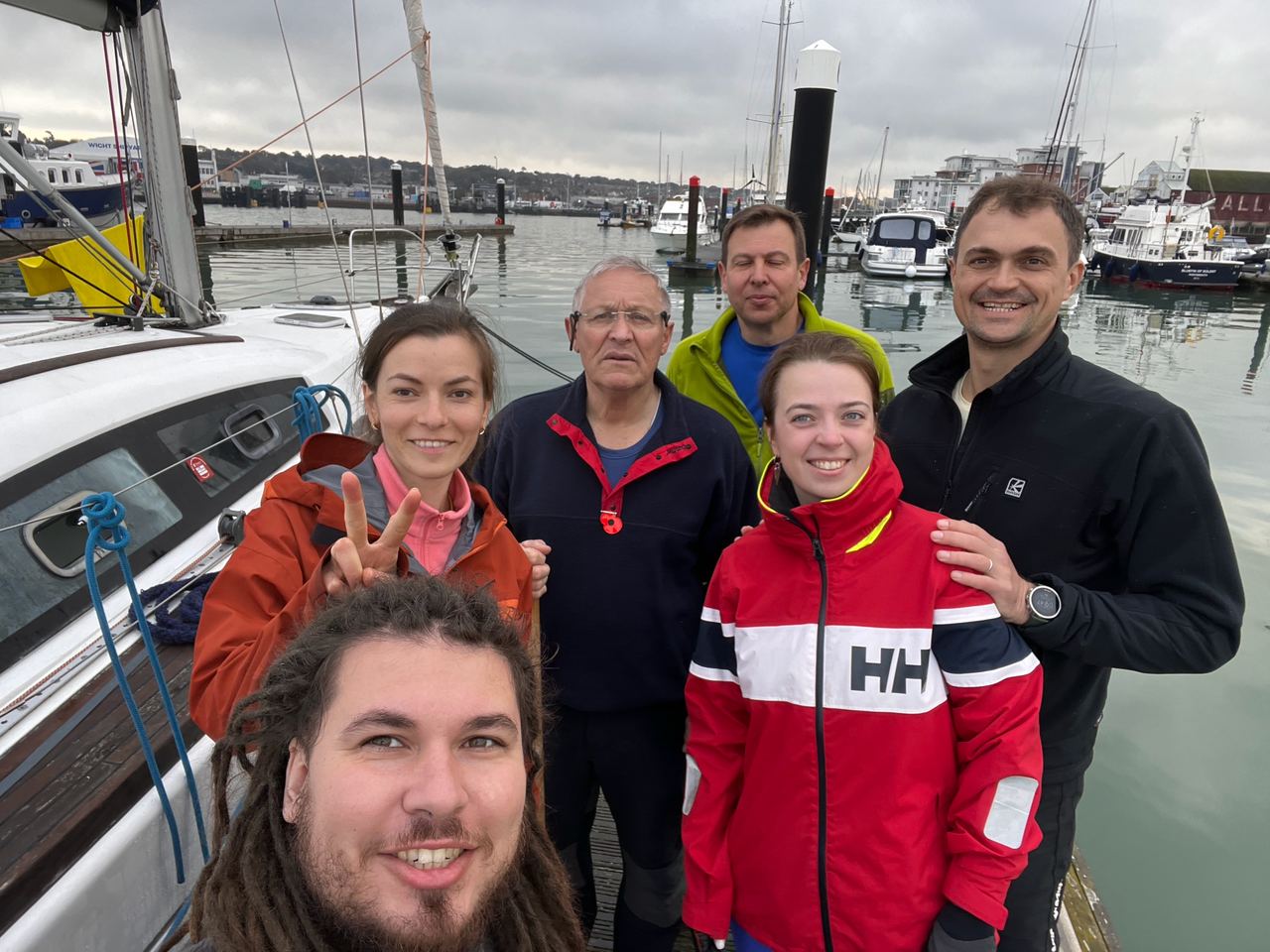
Kabestan. Sleeping bag hire costs an extra £25. Two to a cabin. Showers and toilets in the marina. Five students, with a separate cabin for the instructor.
Students
BSS. Everyone was from Russia: Moscow, the Moscow region, Saratov, Khabarovsk and Kamchatka.
Kabestan. Russian expats from the US, France, Germany, the UAE and England, plus Yulia from Moscow.
Both groups were wonderfully welcoming, friendly and eager to learn. We became a real crew during the course.
Training
BSS. A detailed video course on sailing terminology and yacht systems. Every practical day focused on a technique: tying knots against the clock, berthing, holding a course, turning, or handling sails. Each of us did an exercise three times, then swapped and watched the others. Straight after lunch, we fell asleep for half an hour, then sprang up to prepare the yacht for departure. The duty crew washed the boat every evening. After berthing, lines were coiled, Flemish-coiled, tied in daisy chains or secured with a trucker’s hitch. By the end, there wasn’t a place on the yacht I didn’t know, or a piece of equipment I couldn’t use.
Kabestan. A skipper was appointed each day to plan the passage on the chart: waypoints and compass courses, departure and arrival pilotage, checks before leaving and after arriving, hourly log entries, and handling the boat when berthing. The crew did everything else under the skipper’s supervision. We covered 10–20 miles a day and stopped in different towns. It felt more like sharing a charter, with the instructor making sure we followed good seamanship and didn’t get complacent. He hardly took part in handling the yacht. We corrected one another when we spotted mistakes.
Exams
BSS. A whole day was set aside for a three-hour theory test of 100 questions and an oral radio exam, where answering one or two questions about setting up the radio was enough.
Kabestan. Radio is a separate course with a one-hour exam covering frequencies and channels, the phonetic alphabet, voice procedures and setting up a real radio. Skipper theory is also a separate course, ending with a one-hour exam on navigation problems, IALA buoyage and COLREGs. There were no exams during the Solent practical course, apart from the last day’s exercise: the Day Skipper students navigated using traditional position-fixing methods, while the Coastal Skipper students used only charts and log readings — blind navigation.
Original and discussionOpen post in Telegram ↗