RYA Practice
Day 1 · July 8
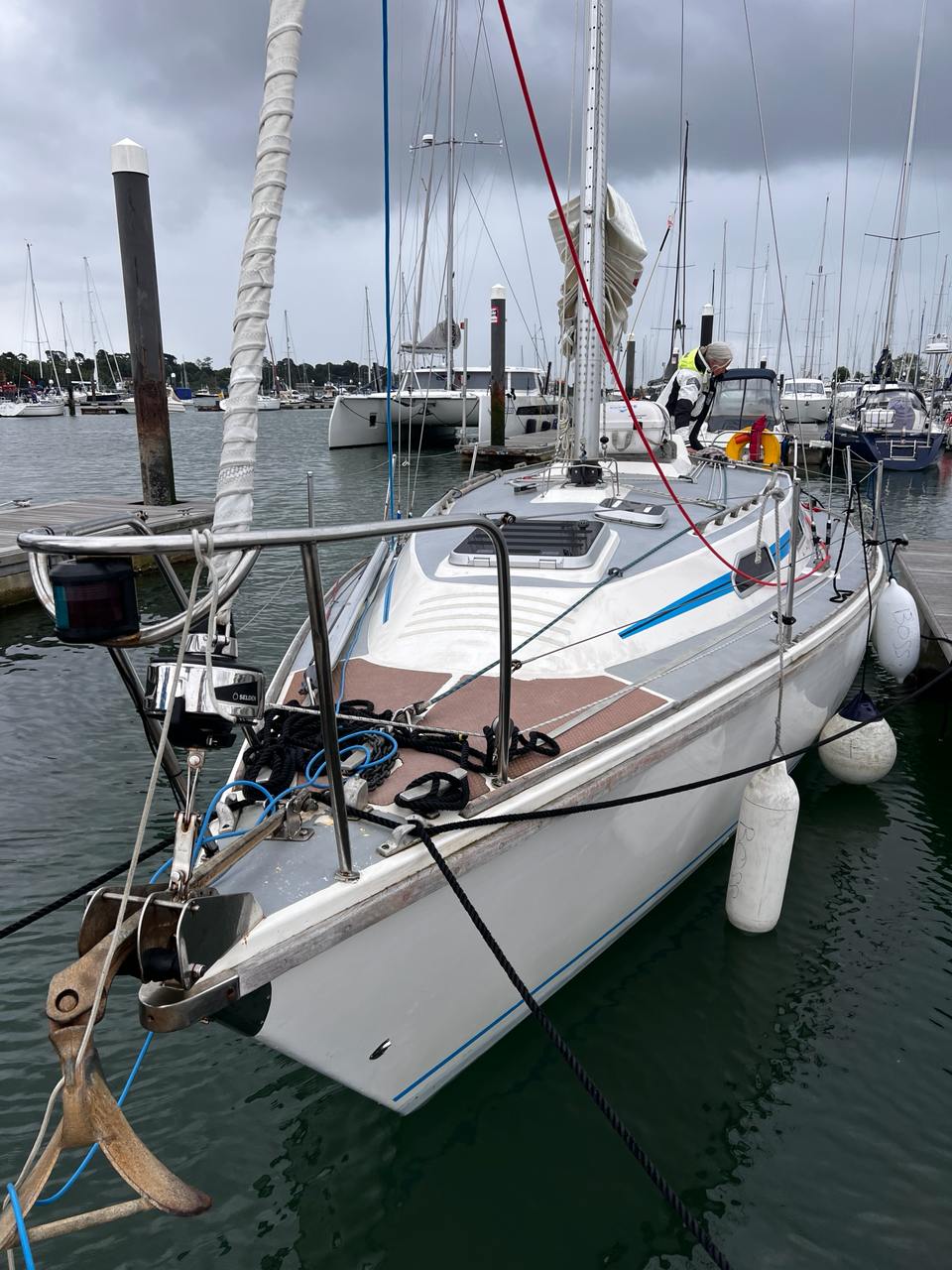
Quite unexpectedly, I decided to take the RYA Coastal Skipper practical course in the Solent. At 8.30am on 8 July 2024, I arrived at British Offshore Sailing School’s office in Hamble marina. Our yacht, Intuition of BOSS, was a 1996 Westerly Fulmar 32: tiller-steered, moderately battered.
Stills from this chapter8 photos · 2 videos
Read the whole chapterCollapse chapter
Introductions first. Jennifer and Philip, a Canadian couple on an eight-week fast track from zero to Yachtmaster Coastal; Roland, British; and our instructor Clive. All retired. They actually had much less experience than I’d expected. Apparently, the real requirements are less daunting than those in my head. Safety briefing: gas, electrics, heads, hatches, pyrotechnics — as he put them away, Clive said, ‘Hope we don’t see those again’ — lifejackets, seacocks, running rigging and WOBBLE engine checks.
Our first outing was engine-handling exercises, about three attempts each:
1. Stopping the boat while underway
2. Stopping on a transit
3. A tight turn
4. Going astern
As the most experienced, I berthed us afterwards. Lunch was reheated baked beans and chicken pie: meat, pepper and potato in puff pastry. After lunch, we studied the forecast on synoptic charts. Force 3–4 today, eight to twelve knots.
Philip was tasked with planning and skippering the passage to the Newtown moorings. A gentle sail. I helmed into the river. The opposing stream was so strong it knocked the rudder from my hands, with water boiling at the edges. Picking up the buoy took about five minutes.
Tea, then Clive’s feedback on what had gone well and what hadn’t. Roland planned the passage to Yarmouth. An hour’s sail, followed by more feedback.
Chicken strips, green beans and potato cakes for dinner. Clive cooked everything.
For overnight homework, I had to plan our passage to the Seaview anchorage. Ideally, we would have gone round the outside of the Isle of Wight, but too much wind was forecast. Planning finished at nine. Everyone went to bed.
Fifteen miles. Track here.
#training #boss #passage
Passage weather
RYA Practice
Day 2 · July 9
Day two. 9 July 2024. Up at six. As promised, Roland had snored all night. Croissants and toast with jam. Checked oil and bilge water, filled the water tank. I handled departure. Not straightforward in England: you have to plan the release of every line for the current wind and stream. Leaving Yarmouth, Clive diverted us to the moorings. Each of us approached a buoy. Phil and I needed one attempt, Jen and Roland two. Then the same under sail.
Stills from this chapter8 photos · 2 videos
Read the whole chapterCollapse chapter
I handled departure. Not straightforward in England: you have to plan the release of every line for the current wind and stream.
Leaving Yarmouth, Clive diverted us to the moorings. Each of us approached a buoy. Phil and I needed one attempt, Jen and Roland two. Then the same under sail. Two attempts for me, three each for Jen and Phil. Roland dropped a tethered bucket over the stern and picked it up first time.
With my plan out, I assigned roles. Almost immediately, torrential rain reduced visibility to a hundred metres. We followed the compass from waypoint to waypoint, meeting the turn of the tide. Tomato and bean cup soup on the way.
At the final waypoint, after changing to engine power in a large swell, something strange happened. Headache. Blinding light. Couldn’t concentrate. I was sent to lie in the saloon, missing the narrow approach to St Helens and anchoring. Roland began planning for Portsmouth. They suggested I come out to look at the horizon. Standing in the rain with trembling legs, I knew any movement would turn me inside out. My first bout of seasickness.
Plan finished, Roland put me at the helm. At the tiller, the sickness eased. We sailed off the wind in a heavy sea. Another downpour removed all landmarks. I simply held the course: any deviation risked grounding. Fifteen minutes later, the cloud passed, revealing a harbour churning with three opposing streams.
I brought us alongside going astern. Curry, rice and cake for dinner, then an instructor’s debrief.
A little terminology:
Slip = cast off = gently release, when referring to a mooring line
Thirty-two miles. Track here.
#training #boss #passage
Passage weather
RYA Practice
Day 3 · July 10
Day three. 10 July 2024. Up at 6.30am. Toast and croissants with jam; Phil had cereal. Clive began with theory: tidal gates, quickly plotting a course to steer with one ruler, and tricks with waterproof charts and pilot books. Lifejackets, cold-water shock and dry drowning. We entered the forecast and tide times in the log and discussed departure options from our berth. In the marina, finger-berth approaches, once or twice each.
Stills from this chapter9 photos · 1 video
Read the whole chapterCollapse chapter
Clive began with theory: tidal gates, quickly plotting a course to steer with one ruler, and tricks with waterproof charts and pilot books. Lifejackets, cold-water shock and dry drowning. We entered the forecast and tide times in the log and discussed departure options from our berth.
In the marina, finger-berth approaches, once or twice each. Then to a buoy for tea and biscuits while Philip planned farther up the river. There, more buoy approaches under sail. Being the youngest worked in my favour: I got 90% of the foredeck jobs and more practice than the others.
Lunch there too: cucumber, tomatoes, avocado, hummus, mayonnaise, pepper, cheese, ham and tortillas. We chopped vegetables and made wraps, with juice to drink. Jen planned Portsmouth to the Beaulieu River.
Third reef in main and genoa. Wind 21–27 knots. Waves broke against us, slowing and knocking us sideways. We unfurled the genoa to the first reef and gained enough speed to hold our course. I helmed. At Bramble Bank, we met two ferries, a cruise ship and two tankers. We circled for twenty minutes between the channel and shoal, letting them pass.
On the mooring, I noticed the genoa had torn along the leech; Phil spotted a broken furling-line fairlead. We fixed the fairlead together, but the sail changed tomorrow’s plans.
Dinner: lasagne, garlic bread and chocolate cake, with fruit squash. A seal swam past.
Meanwhile, Phil planned a night passage to Hamble. Departure at nine. A fascinating three-hour passage with intricate navigation. The Solent has an extraordinary number of lights, and Phil tracked our progress brilliantly by them. Berthed, then hot chocolate and a debrief.
A couple of phrases from the day:
Pumpy — bumpy, uncomfortable conditions on the water
Good catch — spotting or catching something in time
Twenty-seven miles. Track here.
#training #boss #passage
Passage weather
RYA Practice
Day 4 · July 11
Day four. 11 July 2024. Up at seven. Toast and croissants. Weather and tide times entered in the log. We removed the torn genoa for the sail loft. While awaiting a replacement, the instructor covered restricted visibility: types of fog, planning for it, sound signals and watches. Put a lookout on the bow, where it’s quieter. Only one: two start chatting. Change every twenty minutes: prolonged listening and staring lead to imagined sights and sounds.
Stills from this chapter8 photos · 2 videos
Read the whole chapterCollapse chapter
We removed the torn genoa for the sail loft. While awaiting a replacement, the instructor covered restricted visibility: types of fog, planning for it, sound signals and watches. Put a lookout on the bow, where it’s quieter. Only one: two start chatting. Change every twenty minutes: prolonged listening and staring lead to imagined sights and sounds. Then we moved on to heavy-weather techniques.
A knock on the hull: the sail had arrived. My quick bowline caused quite a stir while fitting it. We temporarily set the storm jib over it and discussed its use.
We practised coming alongside from a 90-degree bow-on approach. My turn coincided with peak tidal stream. Astonishingly different from Baltic berthing, like a strong wind.
Roland took us to Osborne Bay for tea. A pleasure sailing with a fresh sail. I dropped the anchor. We heard a Mayday — on the video — while a rainbow-coloured cloud, a rather rare phenomenon, passed overhead.
Clive demonstrated poling out the headsail. He told me to get us underway and head off the wind. We rigged the pole and a mainsail preventer while moving, sailed downwind, headed up onto a close course, then bore away again and took everything down. Jen fixed our position and planned back to Osborne Bay, allowing one metre under the keel at low tide.
Once she came up with her plan, I was tasked with a night passage to Ocean Village Marina in Southampton. With a break for pasta with tomato sauce and chorizo, I finished by nine. Lingering memories from my Day Skipper practical course helped. The sounder showed exactly a metre under the keel. I had Bramble Bank to cross in darkness. Almost all the way across the shoal, I mistakenly used a flashing building instead of the buoy. A spectacular failure. I realised only when the crew spotted the correct buoy abeam. Otherwise, a quiet passage. They applauded my perfect berthing: lovely and embarrassing. One in the morning.
Word of the day: slack — hanging without tension, of a mooring line
Twenty-two miles. Track here.
#training #boss #passage
Passage weather
RYA Practice
Day 5 · July 12
Day five. 12 July 2024. Up at eight. The usual croissants and toast with jam. I checked the engine oil. The instructor spotted contamination in the fuel filter and decided to drain out the water and bacteria. We discussed planning long offshore passages around tidal gates, the sort typically required for a Yachtmaster Offshore exam. Surprisingly, he also gave very positive feedback on my night passage yesterday. Jen planned our route to Netley buoy.
Stills from this chapter10 photos
Read the whole chapterCollapse chapter
I checked the engine oil. The instructor spotted contamination in the fuel filter and decided to drain out the water and bacteria. We discussed planning long offshore passages around tidal gates, the sort typically required for a Yachtmaster Offshore exam. Surprisingly, he also gave very positive feedback on my night passage yesterday.
Jen planned our route to Netley buoy. There, we practised heaving to. The instructor said it was one of the techniques he used most on his own boat: to ride out weather, rest, cook or simply use the loo. Then each of us tried a man-overboard recovery using the same heaving-to technique, as recommended by the RYA.
Clive gave me the tiller, asked us to stow the sails and pick up a nearby buoy for lunch. For the next hour, the crew laughed that I’d chosen the filthiest, most disgusting buoy of the lot.
Lunch was tuna mixed with sweetcorn and mayonnaise, stuffed into rolls with cheese and crisps.
Roland planned the route to the fuel berth and marina. Meanwhile, Clive spoke privately with each of us, offering advice for further development. He said my crew organisation and boat handling were excellent, but I should use more navigation techniques. Always use a hand-bearing compass, for example. I don’t have one, incidentally. I thanked him and said the course had been ‘fascinating’. He laughed for some reason. I never understood why.
On the way back, he told us: ‘A skipper’s job is to organise the crew. If you’ve become a Yachtmaster and still do most of the work yourself, you’re doing something wrong.’
Finally, Clive signed our logbooks, we cleaned the boat, and collected certificates at the office. I’m now an RYA Coastal Skipper.
Eight miles. Track here.
#training #boss #passage
Passage weather
Afterword
What did this course give?
A few thoughts after the RYA Coastal Skipper course, and about British Offshore Sailing School, BOSS, in particular. Everyone on the course, including me, had chosen the school on recommendations. I was surrounded by British people. Even the Canadian couple had British parents and a thoroughly British outlook. I understood everything they said.
Read the whole chapterCollapse chapter
Everyone on the course, including me, had chosen the school on recommendations. I was surrounded by British people. Even the Canadian couple had British parents and a thoroughly British outlook. I understood everything they said. They, though, were clearly less used to talking to someone whose first language wasn’t English, which made me a little withdrawn. Still, everyone was friendly and respectful.
The practical was intensive, very different from Kabestan. We slept six or seven hours, had an hour for washing morning and evening, and spent the remaining fifteen hours training. Sometimes there wasn’t even time to call home. The logbook says it all: as many miles in five days as in ten at Kabestan. Five days really are enough to wear you out.
Five morning jobs:
• check engine oil
• pump the bilge
• fill the water tank
• remove the mainsail cover and prepare the lines
• enter the Shipping Forecast and tide times in the log
Everyone had to do at least one.
Each day had about three passages. One of us became skipper and prepared a passage plan, then gathered the crew round the table for a briefing covering:
• the route
• navigational hazards
• the forecast
• where to hoist and lower sails, and their configuration: reefs and points of sail
Then the skipper assigned roles and rotated them underway. They took the tiller only for departure and berthing, which they also planned. The rest of the time went on supervising the crew, knowing our position and keeping the log.
We used sail whenever possible. If we could leave an anchorage or mooring under main without starting the engine — currents didn’t always allow it — we did.
Planning was thoroughly traditional: chart, protractor, pen and compass. What a joy when, in zero visibility, my calculations brought us to the right spot every time.
So far, I consider this one of the best schools I’ve attended. I’m also proud of all the training I received from Denis Mironov at Black Sea School. He made me an exceptionally competent crew member, whose knots and rigging work often earn approval.
Most importantly, I gained the confidence, and the required tidal miles, to sit the next qualification’s exam.
The full five-day, 105-mile route can be viewed on SailTies.
Drawbacks: joining at eight on Monday morning effectively requires a hotel night. Also, the yacht’s appearance, the worst of any I’ve sailed so far. But that impression fades in the first couple of days.
#training #boss