Introduction
What kind of boat - Great Dane 28
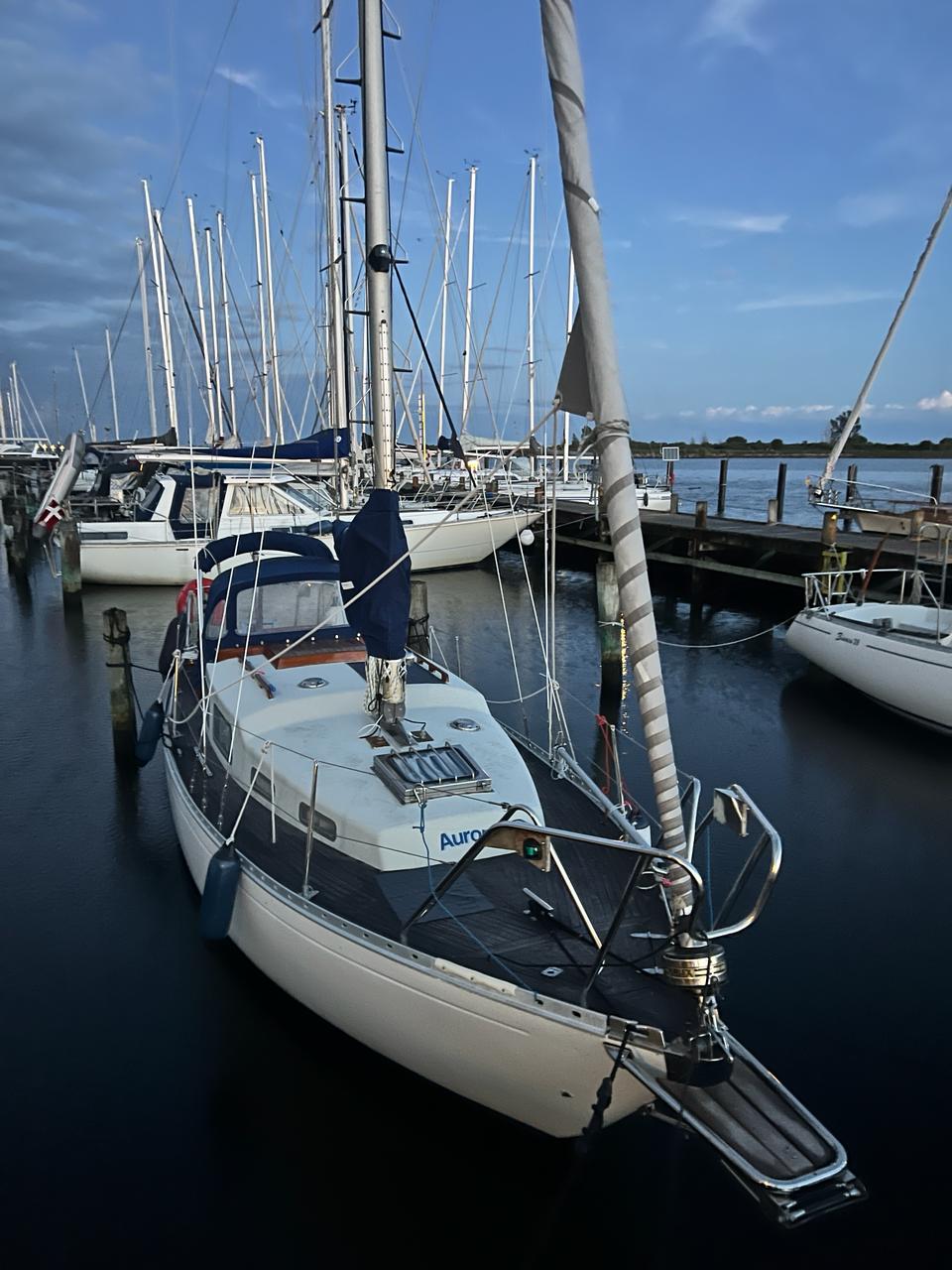
My reasons for choosing the Great Dane had been fairly superficial: an old Danish yacht, a long keel, four tonnes of displacement and plenty of lead down below. Suitable for longer passages. That was it. I wanted to learn more about the boat and what she could do. The more I read, the more interesting my own choice became.
Stills from this chapter3 photos
Read the whole chapterCollapse chapter
My reasons for choosing the Great Dane had been fairly superficial: an old Danish yacht, a long keel, four tonnes of displacement and plenty of lead down below. Suitable for longer passages. That was it.
I wanted to learn more about the boat and what she could do. The more I read, the more interesting my own choice became.
A boat whose time had passed
The Great Dane appeared in Denmark in the mid-1960s. Behind her were Klaus Baess, an Olympic sailor involved in building and exporting boats, and Aage Utzon, who had spent decades designing Danish spidsgatter. He was also the father of Jørn Utzon, the architect of the Sydney Opera House.
They brought their experience of traditional northern boats to fibreglass, still a fashionable new material at the time. The result was 8.5 metres long, with a beam of 2.5 metres, a draught of 1.4 metres and a displacement of four tonnes, including 1.8 tonnes of ballast. A long keel, and a static waterline of just 6.5 metres.
In 1969, the Great Dane won the 25–30 ft class at the Yachting World One-of-a-Kind Rally. The boats were judged on their suitability for cruising, not just speed.
That caught my interest. Here was a boat that had won a comparison of cruising yachts, yet only about 250 were ever built. Why did production stop?
It turned out that in 1980, Klaus Baess decided the Great Dane 28’s time had passed. The production moulds were burnt. I read that detail twice. You can debate whether a boat is outdated, but her creator had put a fairly decisive end to the argument.
Decades later, the very things he had decided to leave behind were what drew me to her.
Among familiar Swedish boats
I find Swedish boats easier to get my head around, so I started with those and then added the British Contessa 32. The similarly sized Albin Vega is much lighter, at just 2.3 tonnes. The Hallberg-Rassy Monsun 31, Marieholm 32E and Contessa 32 are all slightly heavier, at 4.2 tonnes each.
This was where the displacement-to-length ratio, D/L, came in handy: a way to compare boats’ weight in relation to their waterline length. The Albin Vega is around 186, the Monsun 31 around 277, and both the Contessa 32 and my previous boat, the 3.2-tonne Ohlson 29, around 300. The Marieholm 32E comes in at 314, the Storfidra 25 at about 345, and the Great Dane at 391.
That is roughly a third more than Rassvet and the Contessa, and 40% more than the Monsun. Even among these familiar heavyweights, the Dane turned out to carry a lot of weight for her waterline length.
Her ballast ratio sits between the Monsun’s and the Contessa’s: 47% of displacement, against 45% and 48%. In tonnes, that is 1.8 against 1.9 and 2 respectively. In other words, my 28-footer carries almost as much ballast as those 31- and 32-foot yachts.
The price of the trade-off
That high D/L helps explain why I expect less speed in light winds: the sails have to move a lot of weight on a short waterline. After a tack, regaining the speed we’ve lost will take more patience too.
With eight knots of wind, I could get five knots out of Rassvet. For Aurora, I mentally pencilled in twelve knots of wind for the same five knots of boat speed. That is my working guess before getting to know her.
The difference will be even more apparent in the marina. A long keel, more momentum and less freedom to turn in a confined space. I doubt I’ll be doing the pirouettes between pontoons that I was used to on the Ohlson 29.
What I hope to gain
With that same mass, I expect to lose less speed on each crest when heading into waves. The motion comfort ratio, MCR, also favours the Dane: about 34, against 27 for the Monsun and 26 for the Marieholm 32E. Here, the higher figure suggests less abrupt motion. That is exactly what I want on a long passage: to be less worn out by the constant movement.
For short summer outings, that trade-off may still need justifying. For the North Sea and the Atlantic, it makes sense to me. From the Great Dane, I’m hoping for comfort in uncomfortable conditions.
With those thoughts in mind, after selling Rassvet, I bought a FlixBus ticket to Copenhagen and set off to see my new boat.
I wanted to understand the new boat properly. Selling Rassvet had taught me to document a yacht’s maintenance history and specifications in detail. So for Aurora, I put together a separate website in three languages, with more detail about my particular boat.
#notes
The passage
Vallensbæk — Klintholm: first sail
I arrived aboard Aurora on 29 August 2026, my first visit since buying her. The forecast left little choice: leave soon, or wait. I decided to get the boat ready first. The next day went on unpacking, cleaning, buying provisions, replacing the GPSMAP 521s with an ECHOMAP Plus 72sv and fitting AIS.
Stills from this chapter10 photos
Read the whole chapterCollapse chapter
Ten centimetres short of departure
I arrived aboard Aurora on 29 August 2026, my first visit since buying her. The forecast left little choice: leave soon, or wait. I decided to get the boat ready first.
The next day went on unpacking, cleaning, buying provisions, replacing the GPSMAP 521s with an ECHOMAP Plus 72sv and fitting AIS. That last job was particularly important: AIS makes it easier for me to keep track of ships when crossing a traffic separation scheme.
On 31 August, I planned to leave overnight and cover the 80 miles to Gedser while I still had a day’s weather window. But at the last moment, I discovered that the tiller-pilot ram was about 10 cm too short. Using a folded napkin to gauge the distances, I worked out that it could hardly turn the boat to port at all. Departure cancelled.
Fortunately, I was in a big city. The next day, I found an extension. A ten-centimetre threaded stainless-steel tube cost me €50. Anything labelled ‘marine’ automatically becomes expensive. I fitted it and left immediately.
Narrower on paper, roomier in practice
On 1 September, I left at 15:15 and berthed in Klintholm at 23:45: 45 miles in eight and a half hours.
Leaving and berthing both felt quite manageable. I had expected the handling to be much worse.
There were hardly any waves for most of the passage, so it was too early to judge what difference the long keel made. Still, I couldn’t shake the feeling that the boat was cutting through the water rather than bouncing over it. The motion was very gentle. Close-hauled, the apparent wind reached 24 knots. I had the full genoa set and no desire to reef.
To help the sail along, I started the Yanmar 3GM30 and kept it at about 2,200 rpm. My fear that the boat would be slow proved unfounded: we were making at least as much speed as on Rassvet.
There is so much room in the cockpit. I had never felt so free to move around. The boat is narrower, yet somehow feels wider. The cabin is extremely comfortable too. I set a repeating twenty-minute timer on my watch. When it went off, I had a look around, then went below to eat.
How much diesel is left?
There are T-pieces in the fuel supply and return lines, connected by a transparent hose. I was trying to judge the tank level from the fuel visible in it.
I didn’t yet know the consumption, so I checked the hose regularly. When the boat was heeled, the reading made little sense, but the diesel seemed to be disappearing much faster than I was used to. My first estimate was about 15 litres in eight hours: almost two litres an hour, compared with one on Rassvet. At that rate, even the full 40-litre tank wouldn’t last a day under engine.
A few miles short of Klintholm, there was only a 1–2 cm column of fuel left in the hose. To make matters worse, the wind headed us. I had to beat into metre-high waves in the dark.
I ran through the options in my head. If the engine stopped, I would have to enter under sail. But without enough speed, a wave could throw us onto the rocks. I might need help from the rescue service. The VHF wasn’t installed yet, so that would mean calling 112 on my phone.
While I was still thinking it through, I entered the marina and berthed alongside at the fuel station.
How do I stop this thing?
All that remained was to stop the engine. On Rassvet, turning the key had been enough. Here, the key switched off the instrument panel, but the engine kept running.
I started frantically looking for levers and buttons. I found a handle in the locker by the fuel tank and pulled it up. The engine stopped.
I put in 25 litres and worked out that the tank must still have been almost half full. I put the scare down to the hose reading while heeled. A memorable lesson.
For now, Aurora seems to be a boat with character. Or perhaps ‘quirks’ is the word. But I’m more delighted with her every day.
That was enough adventure for one day. I decided to stay at the diesel berth until six in the morning, hoping nobody would urgently need fuel in the middle of the night.
#passage
Passage weather
Stopover
Stranded and a hundred liters of water
On 2 September 2026, I got up at five in the morning. I had berthed at the fuel station in Klintholm the night before and now needed to clear the berth. I started the engine. The wind was blowing from astern and pinning the boat against the pontoon. The proper manoeuvre would have been to use a bow spring to swing the stern clear.
Stills from this chapter4 photos · 1 video
Read the whole chapterCollapse chapter
Morning at the fuel berth
On 2 September 2026, I got up at five in the morning. I had berthed at the fuel station in Klintholm the night before and now needed to clear the berth.
I started the engine. The wind was blowing from astern and pinning the boat against the pontoon. The proper manoeuvre would have been to use a bow spring to swing the stern clear. But I didn’t want to risk scratching the bow. I was also alone aboard and worried I wouldn’t be able to get to the bow and back in time.
So I tried to turn using the engine alone. While I was watching the stern, I missed the wind carrying us towards the rocks. They were only about five metres away. The keel bumped onto a rock, leaving the boat firmly aground.
The boat wouldn’t move in any direction. The shore was out of reach, so I couldn’t take a line ashore and winch myself off. I stood helplessly in the cockpit, wondering what to do.
On another pontoon, three boats were getting ready to leave. I tried shouting and waving my arms in a distress signal. I even got out my whistle. Nobody on any of the three boats looked my way.
About fifteen minutes later, the wind swung the boat round. I gave her some throttle astern and managed to get off without help. After that, I berthed uneventfully. The weather meant I would be staying here for at least four days.
The jobs list
The very first passage had already given me plenty to think about: what was missing from the boat?
The domestic batteries aren’t charging from the engine. I’m planning to fit an Orion-Tr DC–DC charger, but it is rated at 30 A. First, I need to work out how much charging current the alternator can handle. I may need a lower-current charger or a more powerful alternator.
Water is getting into the cabin below the forward port-side window. I need to find the leak, reach it, which looks like the hardest part, and seal it.
There’s no electronic wind instrument. I want to fit a masthead wind sensor and run the cable inside. While I’m at it, I’ll put together an NMEA 2000 network.
The engine produces a white cloud of smoke when started from cold. The manual lists several possible causes, including burning oil. Every item comes with the same recommendation: contact a service centre.
I couldn’t get the gas cooker to light either. The previous owner said the cylinder was half full, but the gauge showed empty. I swapped it for the spare and apparently managed to boil some water.
This is my first gas cooker. As I understand it, cylinders here can be exchanged at dedicated outlets: hand over the empty one, take a full one and pay only for the gas.
The tank with a rubber cap
On 3 September, I tried to fill the freshwater tank. As usual, I left the hose in the deck filler. Some time later, I discovered water in the cabin.
It turned out that the top of the tank was covered by a rubber cap that wasn’t secured to it in any way. The water had gone into the bilge.
I also discovered that the automatic bilge pump wasn’t working. It was getting power and making a noise, but not pumping any water. I still don’t know whether it needs cleaning, replacing or mounting lower down.
I had to pump the water out by hand. A lot of diesel came out of the bilge with it, spreading a slick around the hull. My own little environmental incident in the marina. I hoped nobody would notice and come over to tell me off.
I got the hose out and started washing the boat, spraying water around her as I went to disperse the diesel farther away.
After the first passage, I had been worried about how quickly the fuel was disappearing. Now I had another thought: perhaps some of it had been ending up in the bilge. Where that diesel was coming from was still a mystery.
Kiel had been 160 miles away when I started. So far, I had covered only 40. Windy was forecasting stormy weather for the rest of the week. All I could do was check the forecast every day and hope for a weather window.
#passage
The passage
Via Gedser to Kiel
On 6 September 2026, I waited until two in the afternoon, when the forecast said the gusts should ease to 25 knots, and left Klintholm. On starting, the engine produced a huge white cloud. Under full genoa, I was making about 4.5 knots. But the wind began to shift awkwardly, and for roughly half the passage, about four hours, I motor-sailed at 1,400 rpm.
Stills from this chapter6 photos
Read the whole chapterCollapse chapter
Back to the fuel berth
On 6 September 2026, I waited until two in the afternoon, when the forecast said the gusts should ease to 25 knots, and left Klintholm. On starting, the engine produced a huge white cloud.
Under full genoa, I was making about 4.5 knots. But the wind began to shift awkwardly, and for roughly half the passage, about four hours, I motor-sailed at 1,400 rpm.
Having to start the engine so early was already making me anxious. A light headwind was forecast for the night, which would mean more motoring. I decided to stop in Gedser on the way and arrived around midnight.
A boat was already occupying the fuel berth, with everyone aboard asleep. I was annoyed at first, then remembered I had done exactly the same in Klintholm. I rafted alongside, passed the fuel nozzle across and topped up with 6.5 litres. Consumption at low revs seemed more encouraging.
The forecast was for no wind until morning. I decided to get five hours’ sleep. On 7 September, I left at 06:30.
Performance or comfort
It took ten hours to cover the 39 miles to Heiligenhafen: sailing as close to the wind as I could, with the engine helping for most of the way. It felt as though I had traded Rassvet’s sailing performance for Aurora’s comfort.
In waves of a metre to a metre and a half, I rose and fell gently, almost as though we were in a swell. Rassvet would have been slamming and bouncing around in those conditions.
Even in 20 knots of wind with the genoa fully unfurled, the heel stayed steady at no more than 20 degrees. On Rassvet, I would have expected about 30 degrees, with another five degrees of movement either way. I would have been seriously considering rolling away some genoa. Here, the thought never arose. If anything, it felt as though I needed more sail.
In that wind, Rassvet would make 5.5–6.5 knots under her 140% genoa alone, which was why I didn’t use the mainsail very often. The boats and their sails are similar in size. On Aurora, I was delighted whenever the GPS showed even 4.8 knots. It felt as though I had lost up to a knot and a half. That is far too much. I hope the bottom is simply fouled; we’ll see when she comes out in the autumn. I still need to try the mainsail.
Two rudders
The tiller feels less responsive, but the boat holds her course better. The electric tiller pilot spends long stretches holding it amidships, making only small corrections. In short head seas, though, when a wave knocks the boat off course, it struggles to keep up. Aurora is slow to respond to the helm.
It also feels as though the tiller pilot runs out of travel. I’ll need to get the tape measure out and check the installation. When a steady helm angle is needed to hold the course, it has a hard time. I suspect sail balance plays a part too: I’m sailing under one large genoa.
But Aurora has a useful trick. Her windvane steering has its own rudder blade. I secure that at a slight angle, and the main tiller can come back amidships. That makes life easier for the electric tiller pilot. The two-rudder arrangement works very well.
Three attempts
After a working week in Heiligenhafen, there was still the passage to Kiel, another 40 miles or so. First, I filled up. By then, it felt as though I was refuelling Aurora in every marina, just to be sure I wouldn’t run out.
I wanted to hoist the mainsail at last, but found a broken end stop on the mainsheet traveller. So it was genoa alone again. Early in the passage, I reached 5.5 knots and was absurdly pleased.
Off Putlos, a naval vessel drew level and told me over its loudspeaker to alter course north: there was live firing until 12:30. About halfway through the passage, the wind died. I started the engine again.
Grigory met me in Kiel. Just as well: I couldn’t get into the berth between the piles on the first, second or third attempt. I couldn’t turn tightly enough, while a light crosswind quietly berthed the boat against the pier for me. Rassvet could spin on the spot like a ballerina. I need to get used to this. Right now, berthing is what frightens me most about Aurora.
Grisha assured me it wasn’t as bad as it felt. He pointed out how much momentum the boat carries and noticed that whenever I looked towards the bow, I reduced the tiller angle. He joked that the nerve from my head to my hand was short and pulled my hand round after my head. I’m grateful he noticed. I hope that really is the reason. I’ll practise.
#passage
Passage weather
Maintenance
Workshop on your own engine
Grisha and I had only just relaxed after berthing in Kiel when he said he could smell hot diesel quite strongly. We lifted the cabin sole boards and started looking for the leak. We found oily trails running down from the sealing washers on the fuel connections at the injectors. We agreed to take a closer look a couple of days later.
Stills from this chapter8 photos · 1 video
Read the whole chapterCollapse chapter
Aurora. Part 5. A workshop on my own engine
Hot diesel
Grisha and I had only just relaxed after berthing in Kiel when he said he could smell hot diesel quite strongly. We lifted the cabin sole boards and started looking for the leak. We found oily trails running down from the sealing washers on the fuel connections at the injectors. We agreed to take a closer look a couple of days later.
On Sunday, I had a proper workshop on the fuel system. On my own engine, which made it all the more useful. We started it, varied the revs and stopped it using the levers on the engine itself, without touching the remote controls. We also tensioned the belts by moving the alternator and the raw-water pump.
Diesel was seeping from the connections at the second and third injectors. The copper sealing washers under the bolts need replacing. We found another leak at the fuel-filter outlet. Tightening the hose clip helped, but both the clip and the hose would be better replaced.
A little water was leaking from an exhaust-pipe joint. The hose clip was too large; it needs a smaller one. Gases were also escaping from under the crankcase breather cover, so that gasket needs replacing. While I’m at it, the throttle and gear control could do with a little lubrication.
The oil level was exactly halfway between the two marks on the dipstick. Next season, I’ll keep a close eye on how it changes from one engine run to the next.
I also learnt that my 3GM30 has indirect cooling. Coolant circulates through the engine, while seawater cools it through a heat exchanger.
It was time very well spent. An unfamiliar engine suddenly made much more sense to me. I’m very grateful for the help.
Afterwards, we packed up about ten bags of assorted gear that had come with the boat and took them back to my place.
Two end stops at €20 each
There was one more problem to sort out. Before the final passage, I had wanted to try Aurora with both mainsail and genoa set at last. But one of the end stops on the mainsheet traveller was broken, so I had to abandon that idea. The traveller lets you move the mainsheet’s attachment point across the boat.
At home, I measured the track, end stop and car with a vernier caliper. It’s an old Ronstan RF1293 system with an I-section track about 27 mm wide. It looks exceptionally solid; I hadn’t seen anything like it in the shops. None of the modern alternatives I found matched the dimensions. I was already considering replacing the car just so I could make some use of the mainsail next season.
Then, quite by chance, an Austrian distributor turned out to have three Ronstan RF1287 end stops left for my system. They put me in touch with a German shop that deals with them. Two new end stops are now sitting on my desk.
The pleasant part: just €20 apiece. And, to look at them, about three times as much metal as in their modern equivalents.
Overall
Results of the first 160 miles
When I viewed her, it seemed there was hardly anything to do. Much of what I had planned to fit to Rassvet one day was already there: a windvane self-steering system, recent rigging, a comfortable galley, a fridge and a large table where I could actually work. All that remained was to collect the boat and set off.
Stills from this chapter16 photos
Read the whole chapterCollapse chapter
Aurora. Looking back on the first 160 miles
I’m pleased I moved to a new boat. Happy with her, even.
When I viewed her, it seemed there was hardly anything to do. Much of what I had planned to fit to Rassvet one day was already there: a windvane self-steering system, recent rigging, a comfortable galley, a fridge and a large table where I could actually work. All that remained was to collect the boat and set off.
In the first 160 miles, the jobs list grew considerably.
Almost two weeks afloat
From 1 to 11 September 2026, I sailed Aurora from Denmark to Kiel. The weather was thoroughly unhelpful: I spent days waiting in marinas, checking each new forecast for a chance to move on. Including the preparations before departure, I spent almost two weeks aboard.
I was underway for 36 hours. The rest of the time, I was properly living aboard: working, cooking and learning how the boat’s systems worked. Then a weather window would open and I would move on to the next marina.
I really enjoyed that unhurried way of living afloat. Of course, I didn’t always feel like sitting around waiting for the wind to drop. But being able to live on the boat and change my surroundings from time to time turned out to be rather lovely.
Over the whole route, I covered 160 nautical miles at an average of 4.4 knots. What stayed with me most was the gentle motion. Into the waves, Aurora lifted and lowered me smoothly. That was exactly the sort of comfort I had hoped for.
What still needs doing
The main concern is still diesel consumption. I found myself filling up far too often, with just one thought: don’t run out. We’ve already found some leaks. I’m hoping new copper sealing washers and hose clips will improve matters.
Speed worries me too. On Rassvet, I was used to sailing faster under genoa alone, and so far it feels as though I’ve traded some performance for comfort. But I’ll reserve judgement until next season, after giving the bottom some proper attention. For now, I still want to believe it’s simply fouling.
I also need to learn to berth all over again. The manoeuvres that came naturally on Rassvet don’t work on long-keeled Aurora. Three attempts to get into my own berth made it particularly clear how much practice I still need. I’m comfortable with her at sea; alongside, I’m still rather nervous.
There is certainly plenty to do to make the boat my own. And it isn’t just her systems I need to get used to, but the way she moves and responds to what I do.
People who help
It’s a wonderful thing to have people around who are willing to offer advice or lend a hand. Grisha met me in Kiel and noticed that I was unconsciously reducing the tiller angle. Then he gave me a whole workshop on my own engine. We started it, watched it running and looked for leaks. Afterwards, I understood it much better.
I’m very grateful for that help. Getting to know a new boat together was a pleasure.
Aurora already feels like mine. She is exactly the boat I’ve always wanted. And now I know I’ll be keeping her for years to come.
P.S. Credit for the comic-strip idea goes to Captain Reggie. Should I keep it going and develop it further?